
Problem Solving Games for Toddlers
Problem solving is not just a school skill — it is one of the most important capacities a young child can develop. The toddler who persists with a stuck lid, figures out how to reach a toy on a high shelf, or works out why their tower keeps falling is practising the same fundamental process that underlies every complex skill they will learn in later life: identify the obstacle, generate a strategy, try it, adjust.
These 15 problem solving games for toddlers build thinking, persistence, and the crucial belief that challenges can be worked through — one of the most protective mindsets a child can develop.
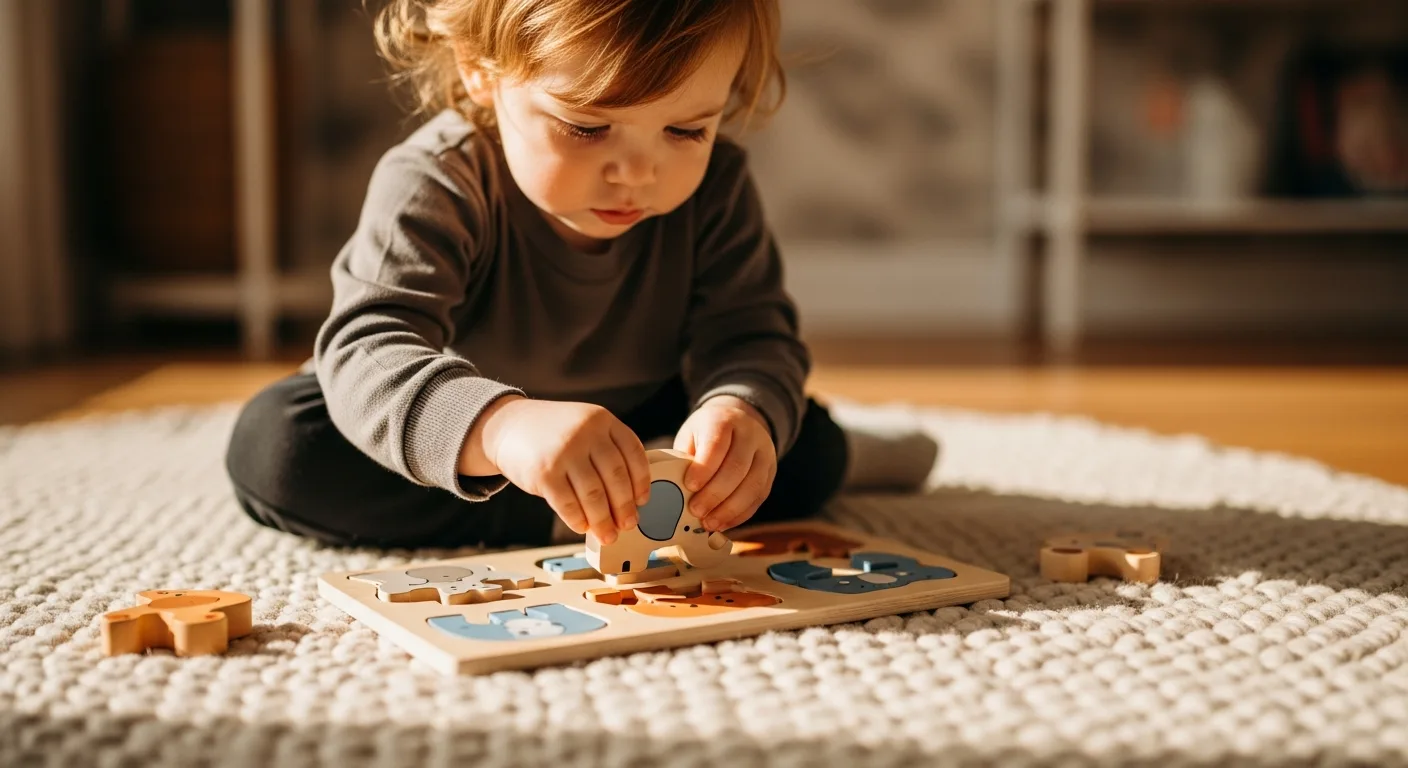
Why Problem Solving Matters for Toddlers
Problem solving in the toddler years develops the executive functions — planning, flexible thinking, working memory, and impulse control — that are more strongly linked to academic and life success than IQ alone. It also builds emotional resilience: toddlers who regularly experience the sequence of encounter-struggle-solution become less frightened of difficulty and more confident in their capacity to manage it.
Builds executive function
Every problem-solving attempt exercises planning, cognitive flexibility, and working memory — the three core executive functions that predict school readiness.
Develops persistence
Toddlers who regularly encounter and work through challenges develop a tolerance for frustration that is one of the most important protective factors in learning and life.
Grows metacognition
Simple reflection — 'That didn't work. What could we try differently?' — plants the seeds of thinking about thinking, which develops into the self-monitoring that skilled learners use.
Builds confidence
Each solved problem is direct evidence of competence. This experiential confidence — earned through genuine effort — is more durable than any praise or reward.
How Toddlers Learn Through Trial and Error
Toddlers are natural scientists. Their approach to any new challenge — try something, observe what happens, try something else — is exactly the scientific method in its purest form. The key to supporting this learning is resisting the urge to solve problems for them. Every time a parent steps in before a toddler has genuinely tried, they remove the learning opportunity. The productive struggle is where the cognitive growth lives. Offer hints and encouragement — not solutions.
15 Problem Solving Games for Toddlers
Egg cup and ball challenge
Place a small ball under one of three upturned cups while your toddler watches, then shuffle them slowly. Can they track and find the hidden ball? This working memory and attention game can start very simply and become more complex as skills develop.
Shape posting box
A classic wooden shape-posting box requires spatial reasoning and persistent trial-and-error to work out which shape fits which hole. The physical feedback — the shape drops in — is immediate and satisfying, making repetition natural.
Container opening challenge
Collect containers with a variety of fastenings — a screw-top jar, a click-lid box, a zip bag, a flip-top bottle. Put a small toy or treat inside each and let your toddler work out how to open them. Real-world problem solving with genuine motivation.
Toy retrieval with a tool
Place a toy slightly out of reach with a stick, ruler, or spoon nearby. Can your toddler work out how to use the tool to retrieve the toy? Tool use — the understanding that an object can extend your reach — is a significant cognitive milestone.
Simple maze navigation
Draw a simple maze on paper or create one with cardboard walls. Ask your toddler to guide a toy car or marble through. Maze navigation requires planning ahead, recognising dead ends, and trying alternative routes.
Lock and key sets
Toddler-sized lock and key sets — where differently shaped keys open different locks — require spatial matching and persistent trial-and-error. The satisfying click of an opening lock provides the immediate feedback that drives continued engagement.
Nesting and stacking cups
A set of nesting cups can be stacked from largest to smallest or nested inside each other. Working out the correct order — and what goes wrong when it is incorrect — develops seriation thinking and spatial reasoning simultaneously.
Reverse engineering a toy
Give your toddler a toy they know well and ask them to take it apart (where safely possible) and put it back together. The disassembly and reassembly require a different kind of spatial thinking than building fresh.
The marble run challenge
A basic marble run set requires a toddler to connect sections in a specific sequence that will allow the marble to travel from top to bottom. The immediate feedback of a successful or failed run makes the problem-solving loop fast and clear.
Rescue the toy from the net
Put a small toy inside a mesh bag or loosely knotted scarf and challenge your toddler to rescue it without help. Working with fastenings, knots, and barriers develops persistence and spatial manipulation skills.
Balancing challenges
Challenge your toddler to balance different objects on a narrow surface — a toy on a narrow block, a stone on a curved surface. What adjustments are needed? What keeps things from falling? Balance and equilibrium are physical problems with a clear feedback loop.
Sorting by function
Mix a collection of objects that belong in different rooms (kitchen, bathroom, bedroom) and ask your toddler to sort them into the right groups. This categorisation-by-function challenge is more cognitively demanding than sorting by colour or size.
Simple two-piece puzzles
Cut a large picture card in half and ask your toddler to reassemble it. Progress to three pieces, four pieces, and then commercially available chunky puzzles. Each level introduces new spatial reasoning challenges.
Getting from here to there
Set up a simple obstacle — cushions on the floor, a pile of books — between your toddler and a target toy, and ask them to figure out how to get the toy without crossing the obstacle directly. Spatial planning and lateral thinking in one short activity.
Guess what's in the bag
Place familiar objects in a cloth bag and ask your toddler to identify them by touch alone without looking. Using tactile information to form a mental picture of an object is a sophisticated problem-solving task that builds spatial and sensory reasoning.
Encouraging Curiosity and Persistence
- ⏳
Wait before helping
Count to thirty silently before offering any support. The discomfort of watching your toddler struggle is almost always worth resisting — the struggle is where the learning happens.
- 💡
Offer hints, not solutions
'Hmm, what if you tried turning it the other way?' gives your toddler the next step to try without removing the problem-solving experience entirely.
- 🔄
Celebrate the attempt, not just the result
'You kept trying even when it was hard — I noticed that' is more cognitively useful than 'Well done, you did it!' It names the process skill you want to develop.
- 🎲
Play alongside, not for
Working on your own puzzle or project while your toddler works on theirs models focused persistence and shows that problem-solving is worth sustained effort.
For structured games that build similar skills, our Educational Games for Toddlers guide has a broad range of age-appropriate options. And our Learning Through Play at Home guide covers how to set up the broader play environment that makes this kind of independent problem-solving possible.
Looking for fun activities for your toddler?
Try our Toddler Activity Generator to instantly get indoor and outdoor activity ideas based on your toddler's age.
Try the Toddler Activity GeneratorNeed toddler meal ideas too?
Use our Toddler Meal Generator to quickly find breakfast, snack, and dinner ideas.
Try the Toddler Meal GeneratorFinal Thoughts
Problem solving skills for toddlers are built one small challenge at a time — one stuck lid, one impossible puzzle piece, one tower that keeps falling. Your job is not to make it easy, but to make it safe to struggle: to be present, encouraging, and patient as your toddler works it out. The child who learns that problems yield to persistence, curiosity, and creative thinking carries that lesson for a lifetime.