Educational Games for Toddlers
Toddlers do not separate play from learning — for them, they are the same thing. Every game they play, every object they explore, every cause-and-effect relationship they discover through trial and error is genuine learning. The best educational games for toddlers do not feel like lessons; they feel like fun. And the best part? Most of them require nothing more than everyday objects and a few minutes of your time.
This guide gives you 20 simple, proven toddler learning games you can play at home today — each one with a clear explanation of what your toddler is learning and a practical tip for making it work even better. No expensive equipment needed. No preparation required. Just play.
Why Educational Games Are Important for Toddlers
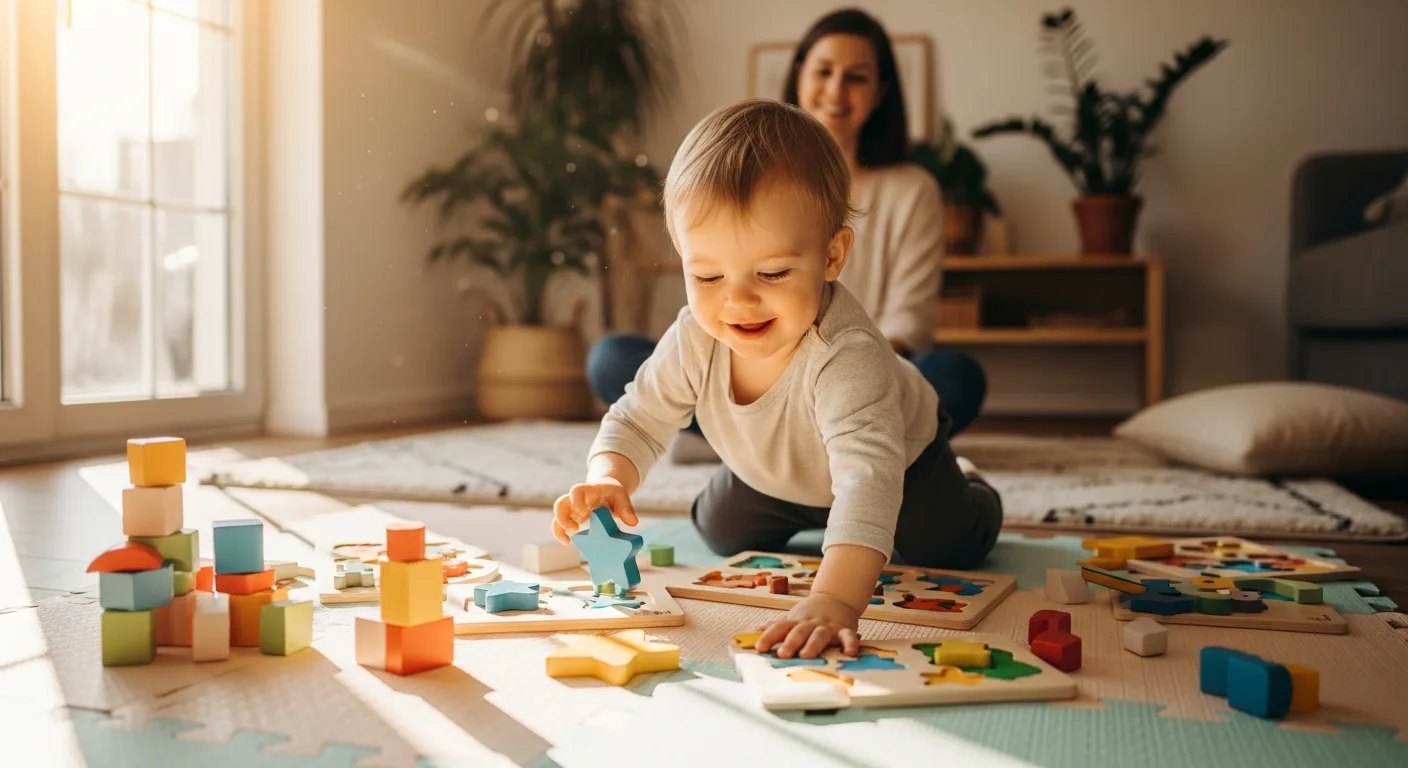
Toddler educational activities support development across every domain simultaneously — cognitive, physical, social, and emotional. Simple games are one of the most efficient and enjoyable ways to provide the rich, varied stimulation that a growing toddler brain needs.
Supports cognitive development
Games that involve sorting, matching, sequencing, and problem-solving build the neural pathways that underpin thinking, reasoning, and learning. The toddler brain forms connections at an extraordinary rate during play.
Improves problem-solving skills
When a puzzle piece does not fit, a tower falls, or a plan does not work, toddlers learn to adjust their approach, try again, and persist through frustration. This is real, transferable problem-solving practice.
Builds language and communication
Every game creates opportunities for vocabulary — naming, describing, questioning, and narrating. The language that surrounds educational games is often as developmental as the game itself.
Strengthens fine motor skills
Sorting, stacking, placing, threading, and tracing all build the hand strength and precision that underpin writing, drawing, and self-care skills. These physical skills need thousands of repetitions to develop — games provide them joyfully.
Encourages curiosity and exploration
Games that reward experimentation — what happens if I put this here? what if I try it a different way? — build the habit of curiosity that is the foundation of all future learning. Curiosity is a skill, and it is built through play.
20 Educational Games for Toddlers
These learning games for toddlers cover language, maths, science, motor skills, and social development — all through play. Most need zero preparation and use things you already have at home.
Colour sorting game
Set out coloured containers — muffin tins, bowls, or cups — and a collection of objects in matching colours. Ask your toddler to sort everything into the right group.
What they learn
Colour recognition, categorisation, concentration
Parent tip
Start with just two colours and add more as confidence grows. Praise the process: 'You found all the red ones!'
Matching shapes game
Use a shape sorter, homemade shape cards, or cut shapes from card. Ask your toddler to find the matching shape or slot each piece into the right space.
What they learn
Shape recognition, visual discrimination, problem-solving
Parent tip
Name each shape as they place it. 'That's a triangle — it has three corners. Can you feel them?'
Counting toy game
Count small toys, blocks, or snack pieces together. Place them in a line and touch each one as you count. Ask your toddler to count them back to you.
What they learn
Number sense, one-to-one correspondence, early maths
Parent tip
Keep groups small — three to five items for young toddlers. Count slowly and point to each one deliberately.
Alphabet puzzle play
A chunky foam or wooden alphabet puzzle introduces letters through touch and play. Focus on familiar letters first — the ones in your toddler's name.
What they learn
Letter recognition, fine motor skills, early literacy
Parent tip
Sing the letter sound as you place each piece: 'S says sssss, like snake.' Sound over name is more useful at this stage.
Memory card matching
Lay out four to six pairs of picture cards face down and take turns flipping two at a time to find matches. Start with just four cards (two pairs) for very young toddlers.
What they learn
Working memory, concentration, turn-taking, visual recall
Parent tip
Use cards with familiar images — animals, food, vehicles. Familiarity reduces cognitive load and makes the task accessible.
Stacking blocks challenge
Build a tower together and see how high it can go before it falls. Challenge your toddler to beat their previous record, or build two towers and compare their heights.
What they learn
Spatial reasoning, balance, counting, cause and effect
Parent tip
Narrate as you build: 'This one is bigger so it goes on the bottom to keep it stable.' Engineering vocabulary slips in naturally.
Object naming game
Point to everyday objects around the house and ask your toddler to name them. Then swap — you point and they name, or they point and you guess. Describe the object before naming it.
What they learn
Vocabulary, language development, classification
Parent tip
Go beyond the name — add a property: 'Yes! A cup — a blue, round cup. What do we use it for?'
Animal sound guessing game
Make an animal sound and ask your toddler to guess which animal it is. Take turns — let them make sounds for you to guess too. Add movement to make it even more fun.
What they learn
Language, memory, listening skills, turn-taking
Parent tip
Use picture cards or a book to show the animal after guessing. Connecting the sound to the image reinforces the learning.
Simple scavenger hunt
Give your toddler a list of things to find — either verbally or with picture clues. Items can be around the house, garden, or on a walk. Start with three to five items.
What they learn
Listening comprehension, problem-solving, observation, memory
Parent tip
Keep the list short and achievable. Celebrate every find enthusiastically — the feeling of success is what motivates the next attempt.
Musical rhythm game
Tap a simple rhythm on the table or with a wooden spoon and ask your toddler to copy it. Start with one tap, then two, gradually building complexity as they get the hang of it.
What they learn
Listening, rhythm, pattern recognition, memory
Parent tip
Use kitchen utensils as drums. The fact that they are 'real' objects (not toys) usually increases engagement significantly.
Toy sorting by size
Gather a collection of similar objects in different sizes — toy cars, spoons, blocks — and ask your toddler to put them in order from smallest to biggest.
What they learn
Size comparison, ordering, early maths concepts, vocabulary
Parent tip
Use the language of comparison: 'bigger', 'smaller', 'biggest', 'tiny'. This builds the mathematical vocabulary of comparison.
Stacking cup challenge
A set of nesting cups can be stacked, nested, used in water play, or ordered by size. Challenge your toddler to stack them in the right order or build the tallest tower they can.
What they learn
Size ordering, fine motor skills, spatial reasoning, problem-solving
Parent tip
Introduce the concept of biggest-at-the-bottom naturally: 'Which one should go at the bottom to make it strong?' Then test it.
Pretend grocery shopping
Set up a pretend shop with tins, fruit, and toys. Give your toddler a simple list (or pictures) and ask them to find and 'buy' each item. Take turns being the shopkeeper.
What they learn
Language, imaginative play, following instructions, counting
Parent tip
Add numbers: 'Can you get me two apples?' and money: 'That costs three pennies.' Basic maths concepts embed naturally in play.
Shape tracing game
Draw simple shapes on paper and ask your toddler to trace over them with a crayon or their finger. Start with large shapes and progress to smaller ones as fine motor control develops.
What they learn
Fine motor skills, shape recognition, pre-writing skills
Parent tip
Use foam shapes or cardboard templates to trace around as an alternative — the physical tracing of the edge is equally valuable.
Ball rolling coordination game
Sit opposite each other and roll a ball back and forth. Introduce a target — a gap between two blocks — or vary the speed and direction to increase the challenge.
What they learn
Gross motor coordination, tracking, turn-taking, spatial awareness
Parent tip
Make it silly: celebrate dramatically when they succeed, and use exaggerated movements to keep the energy light and fun.
Picture matching game
Lay out a collection of picture cards and ask your toddler to find matching pairs or group cards by category — all the food, all the animals, all the vehicles.
What they learn
Visual discrimination, categorisation, vocabulary, concentration
Parent tip
Use real photographs alongside illustrations — the mix of image types sharpens visual recognition and adds variety.
Simple puzzle solving
Start with two-to-four piece puzzles and work up to more complex ones as skill develops. The physical act of rotating, trying, and fitting pieces builds spatial reasoning through direct experience.
What they learn
Spatial reasoning, problem-solving, fine motor skills, persistence
Parent tip
Resist helping immediately. Give your toddler a moment to try. The struggle is where the cognitive growth happens.
Nature object matching
Collect leaves, stones, acorns, and sticks on a walk. Back home, draw around them to create matching silhouettes on paper and ask your toddler to match each object to its outline.
What they learn
Visual matching, observation, early science, fine motor skills
Parent tip
Talk about the properties: 'This leaf is smooth and yellow. This one is rough and brown.' Descriptive language builds vocabulary and observation skills simultaneously.
Toy car ramp experiment
Prop a piece of cardboard or a wooden board at an angle to create a ramp and send toy cars or balls down it. Change the angle, the surface, or the vehicle and observe what happens.
What they learn
Cause and effect, early science concepts, prediction, curiosity
Parent tip
Ask predictive questions: 'Do you think the big car or the small car will go faster?' Then test it and talk about what you noticed.
Balloon keep-up game
Blow up a balloon and try to keep it in the air by tapping it gently back and forth. Count how many taps you can get before it touches the floor. It sounds simple — toddlers adore it.
What they learn
Gross motor coordination, tracking, counting, reaction time
Parent tip
Count each tap aloud together. Toddlers are far more motivated to count something they care about than abstract numbers on a page.
For even more activity ideas, the fun indoor activities for toddlers guide and the outdoor activities for toddlers guide each have 25 more ideas covering all settings and ages.
Tips for Making Learning Games Fun
The most simple learning games for toddlers work best when the emphasis stays firmly on enjoyment. These principles keep games genuinely fun — and genuinely educational.
Keep activities short
Toddler attention spans are typically between five and fifteen minutes for any single activity. Short, successful sessions build positive associations with learning games. Stop before they get bored — always leave them wanting more.
Let toddlers explore freely
Resist the urge to direct every move or correct every approach. If your toddler uses the puzzle pieces as pretend food, or sorts the colour tiles in a way you did not expect, that is play — let it happen. The learning follows the engagement.
Celebrate effort rather than perfection
The goal of educational games for toddlers is not to produce correct answers — it is to build positive feelings about learning, problem-solving, and discovery. 'You worked really hard at that puzzle' matters more than 'You got it right.'
Follow your toddler's interests
A dinosaur-obsessed toddler will learn far more from dinosaur-themed sorting and counting games than from any generic educational activity. Wrap the learning in the thing they love, and the learning takes care of itself.
How Play Supports Toddler Development
Play-based learning games support every area of toddler development — often several simultaneously. Understanding what each type of game builds helps you choose activities that meet your toddler's needs at any given moment.
Language skills
Every educational game creates natural opportunities for vocabulary — naming objects, describing properties, narrating actions, and responding to questions. The language that surrounds play is often more educational than the activity itself.
Motor coordination
Sorting, stacking, threading, and placing all build the fine motor control that underpins writing, drawing, and self-care. Gross motor games — ball rolling, dancing to rhythms — build the physical coordination and body awareness that support physical confidence.
Social interaction
Turn-taking, waiting, winning, losing, and cooperating on a shared goal are all practised through simple games. These are genuinely complex social skills, and the game context makes the practice feel natural rather than instructed.
Creativity
When toddlers are free to use game materials in their own way — arranging puzzle pieces into a pattern, using sorting cups as a pretend tea set — they are exercising creative and divergent thinking. The most educationally rich games are the ones flexible enough to be played in multiple ways.
For a deeper look at how play drives all areas of development, the learning through play at home guide covers the research and practical strategies in detail.
Looking for toddler meal ideas too?
Try our Toddler Meal Generator to get quick breakfast, snack, and dinner ideas for your toddler.
✨ Try the Toddler Meal GeneratorMore Helpful Toddler Resources
Final Thoughts
The most effective toddler brain development games are not the most expensive, the most elaborate, or the most educational-looking. They are the ones your toddler genuinely wants to play — the ones that create that look of absorbed concentration or squealing delight that tells you something real is happening.
A pile of blocks, a set of plastic cups, a handful of buttons, or a walk around the block are all the raw material you need. The educational ingredient you supply is your presence, your enthusiasm, and your willingness to get on the floor and play alongside them.
You do not need to turn every game into a lesson — and you should not. Trust the play. Trust your toddler. The learning is already happening.