
Screen-Free Learning Ideas for Toddlers: 15 Activities for Curious Minds
In a world where screens are everywhere and often function as the easiest solution to a restless toddler, intentional screen-free learning time has become one of the most valuable things parents can offer. Not because screens are inherently harmful in moderation, but because the alternative — unstructured, hands-on, screen-free play — builds cognitive, social, and physical skills that no app currently replicates.
This guide explains why screen-free learning matters, offers 15 practical activities that encourage deep, joyful engagement, and gives realistic tips for building screen-free time into even the busiest family day.
Why Screen-Free Learning Matters for Toddlers
The American Academy of Pediatrics recommends no screen time for children under 18–24 months (except video calling), and limited, high-quality screen time for toddlers aged 2–5. The reasoning is not that screens are toxic, but that toddler brains learn most effectively through multi-sensory, embodied, interactive experiences — and screen time displaces these.
Research consistently shows that toddlers learn language, concepts, and skills more effectively from real-life interaction than from video content — even high-quality educational videos. A child learns the word "water" more durably from splashing in a bowl than from hearing it on a tablet. They develop spatial reasoning more effectively from building with blocks than from a building app.
Screen-free time also supports longer attention spans, more creative play, better sleep, and a richer relationship with the physical world. For more on how play drives learning, see our Learning Through Play at Home guide.
15 Screen-Free Learning Activities for Toddlers
Block building
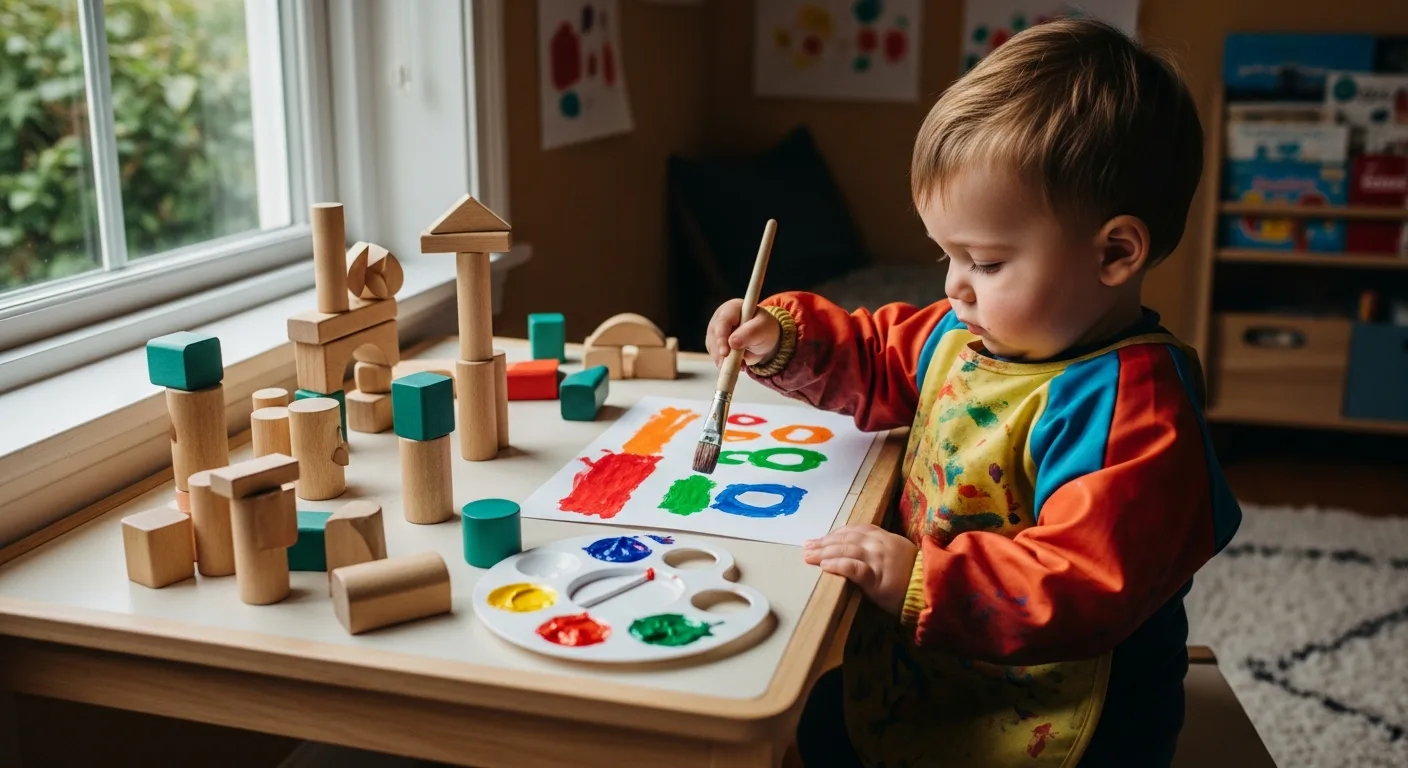
Open-ended block play develops spatial reasoning, mathematical thinking, problem-solving, and fine motor control. Offer a variety of shapes and sizes and resist the urge to direct the build.
Water play
A bowl, tray, or small water table with cups, funnels, and spoons teaches volume, cause and effect, and scientific observation in the most joyful way possible.
Playdough and clay
Rolling, squeezing, poking, and moulding playdough builds hand strength, creativity, and concentration. Add simple tools — toothpicks, rolling pins, cookie cutters — to extend play.
Sorting and grouping
Set up a tray of mixed objects — buttons, shells, dried pasta, coins — and invite sorting by colour, size, shape, or texture. This builds early maths and categorisation skills.
Painting and drawing
Open-ended art encourages self-expression, fine motor development, and cause-and-effect thinking. Use large paper, chunky brushes, and a variety of materials including vegetables for stamping.
Jigsaw puzzles
Start with large knob puzzles and build up to more pieces as skills develop. Puzzle-solving builds spatial awareness, persistence, and hand-eye coordination.
Sand and soil play
Digging, scooping, and filling in a sandpit or garden patch is absorbing, sensory-rich, and builds scientific understanding through direct physical exploration.
Dramatic play / role play
Dressing up, playing shop, cooking in a toy kitchen, or caring for dolls builds social understanding, language, emotional regulation, and narrative thinking simultaneously.
Simple science experiments
Baking soda and vinegar fizzing, ice melting in warm water, mixing colours with food colouring — safe, simple experiments make science concrete and magical.
Gardening
Planting seeds, watering, observing growth, and eventually harvesting gives toddlers a slow, satisfying, real-world science experience. Even a small pot on a windowsill works.
Story retelling with props
After reading a book, offer small toys or objects that match the story and invite your toddler to retell it. This builds narrative language and comprehension.
Obstacle and movement courses
Build a course using cushions, tunnels, low steps, and hoops. Navigating it builds gross motor skills, spatial awareness, and sequencing ability.
Matching games
Homemade or commercial matching and memory games — match the animal to its home, the colour to the shape — build visual discrimination and working memory.
Baking and cooking together
Measuring, pouring, mixing, and observing transformations in the kitchen teaches maths, science, and sequencing — and produces something delicious at the end.
Music and instrument exploration
Offer a range of simple instruments — drum, shaker, xylophone, bells — and encourage free exploration. Music play builds auditory discrimination, rhythm, and creativity.
Home Learning Tips for Screen-Free Days
You do not need a fully stocked playroom or expensive resources to create a rich screen-free learning environment. What toddlers need most is open-ended materials (things that can be used in many ways) and a consistent, calm space where they can play with some independence. Rotate toys weekly to maintain novelty — a toy that has been out of sight for two weeks is often greeted with fresh enthusiasm.
Set up activities in advance when possible — a tray of art supplies on the table, a bowl of water in the garden — so that the environment invites engagement without requiring you to be constantly interactive. Allow for productive struggle: a toddler who is mildly challenged by a puzzle is learning more than one who finds it too easy or too hard.
The best screen-free days are built on a reliable rhythm. Knowing what to expect helps toddlers settle into activities rather than seeking constant stimulation. For help with daily rhythm, see our Simple Toddler Routine Tips.
Final Thoughts
Screen-free learning does not require perfection or elaborate setups. It requires consistent access to open-ended materials, a parent who narrates and responds, and enough time and space for deep play to unfold. The 15 activities in this guide are all achievable in ordinary homes with ordinary materials — start with one or two and build from there. For more ideas, use our Toddler Activity Generator.
Want More Screen-Free Activity Ideas?
Use our Toddler Activity Generator for instant, age-appropriate learning ideas your toddler will love.
Try the Activity Generator →Need Meal Ideas?
Try our Toddler Meal Generator for personalised, age-appropriate meal ideas in seconds.
Try the Meal Generator →Get the 30 Easy Toddler Recipes PDF
Download our printable recipe guide — 30 quick, toddler-approved meals your family will love.
Get the 30 Easy Toddler Recipes PDF →