
Learning Through Play at Home
Toddlers are learning every single minute of the day — not in spite of play, but through it. Play is not a break from learning; it is the primary mechanism through which young children develop language, problem-solving skills, creativity, emotional regulation, and the foundational maths and literacy concepts they will build on for years to come. Learning through play is not a teaching method invented by early years educators — it is how toddlers are wired to learn.
The extraordinary news for parents is that you do not need special equipment, an educational background, or elaborate activity plans. Your home — with its everyday objects, ordinary routines, and your warm, engaged presence — is already a rich learning environment. This guide gives you fifteen practical toddler learning activities you can do at home today, along with the research and reasoning behind why play-based learning works so well.
Why Play Is Important for Toddler Learning
When a toddler plays, their brain is working harder than it might appear from the outside. Research in early childhood development consistently shows that play-based learning for toddlers supports every major area of development simultaneously — and more effectively than structured instruction at this age.
Supports brain development
Play stimulates the formation of neural connections in the developing brain. Exploratory play — touching, sorting, building, experimenting — is particularly powerful for brain architecture. The first three years of life are a critical window for this development.
Encourages creativity and imagination
Imaginative play — pretending a block is a car, or that a cardboard box is a house — develops abstract and creative thinking. This capacity for symbolic thought is a foundational cognitive skill that supports later reading, problem-solving, and innovation.
Builds problem-solving skills
When a tower falls, a puzzle piece does not fit, or a plan does not work out, toddlers learn to try again, adjust their approach, and persist in the face of frustration. This is genuine problem-solving — and it transfers to every area of life.
Strengthens language and communication
Play — especially play with a responsive adult — is one of the most powerful drivers of language development. Narrating play, asking questions, and responding to a toddler's attempts to communicate all build vocabulary, sentence structure, and conversational skills at remarkable speed.
How Toddlers Learn Through Everyday Play
Learning activities for toddlers at home do not require any special preparation. Some of the richest toddler development activities are built into the ordinary rhythm of the day:
Building with blocks
Introduces early maths and physics concepts — gravity, balance, volume, and spatial relationships — through direct hands-on experience that no worksheet could replicate.
Reading books
Builds vocabulary, comprehension, narrative understanding, and early literacy foundations. Toddlers who are read to regularly arrive at school with significantly richer language than those who are not.
Playing pretend
Develops symbolic thinking, imaginative capacity, social understanding, and language. Pretend play is where toddlers process their understanding of the world and rehearse social roles.
Exploring outdoors
Supports scientific thinking, sensory development, physical coordination, and genuine curiosity about the natural world. The outdoor environment is endlessly novel and stimulating in ways no indoor activity can fully replicate. See the for more.
Music and movement
Develops rhythm, language patterns, body awareness, and gross motor coordination. Singing together is particularly powerful for language development — the rhythm and repetition of songs support word learning and memory.
For a full list of ideas sorted by setting, the fun indoor activities for toddlers guide and the outdoor activities for toddlers guide both have 25 activity ideas each.
15 Learning Through Play Activities for Toddlers
These educational toddler activities can all be done at home with materials you likely already have. Each one is genuinely enjoyable for toddlers — not a disguised worksheet — and each one supports real developmental learning.
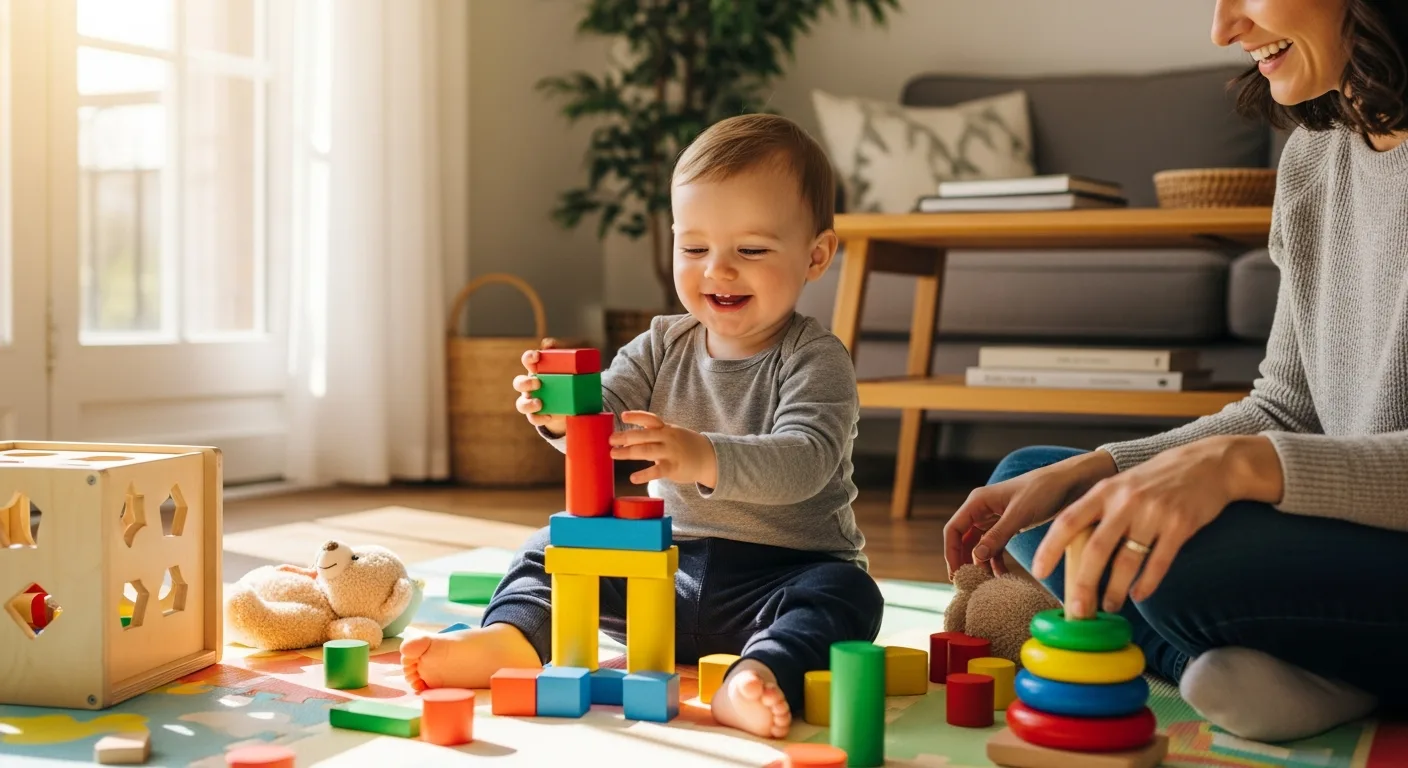
Building towers with blocks
Stack, knock down, and rebuild — it never gets old for toddlers. Block play develops spatial awareness, hand-eye coordination, and early maths concepts like height, balance, and cause and effect.
What they learn
Spatial reasoning, fine motor skills, early maths
Parent tip
Narrate what you're doing: 'I'm putting the big one on the bottom to make it stable.' This builds vocabulary alongside the play.
Sorting toys by colour or shape
Set out a collection of objects and ask your toddler to sort them into groups. Muffin tins, egg cartons, or simple coloured containers make it tactile and fun.
What they learn
Categorisation, colour and shape recognition, early logic
Parent tip
Start with just two colours or shapes before introducing more. Keep it achievable and praise the effort, not just the result.
Reading picture books together
Reading aloud is one of the single most powerful things a parent can do for a toddler's development. Beyond vocabulary, it builds comprehension, empathy, attention span, and a lifelong love of books.
What they learn
Language, vocabulary, comprehension, emotional literacy
Parent tip
Ask questions as you read: 'What do you think will happen next?' or 'How does the bear feel?' This turns passive listening into active engagement.
Singing songs with actions
Action songs — Heads, Shoulders, Knees and Toes; The Wheels on the Bus; If You're Happy and You Know It — combine movement, rhythm, language, and memory in one irresistible package.
What they learn
Language patterns, memory, gross motor coordination, rhythm
Parent tip
Slow down the actions deliberately — toddlers need time to process and follow. Let them lead sometimes and follow their version.
Simple puzzles
Chunky wooden puzzles and simple shape sorters give toddlers a problem to solve through trial and error. The satisfaction of completing a puzzle builds persistence and confidence alongside cognitive skills.
What they learn
Problem-solving, spatial reasoning, persistence, fine motor skills
Parent tip
Sit with them but resist jumping in too quickly. Let them try for a moment before offering a gentle hint. The struggle is where the learning happens.
Pretend cooking or shopping
Imaginative play — a toy kitchen, a pretend shop, or even a cardboard box with a few tins from the cupboard — is where some of the most important early learning happens. Pretend play requires toddlers to hold ideas in mind, take on roles, and narrate their own actions.
What they learn
Language, imagination, social skills, symbolic thinking
Parent tip
Join the play enthusiastically. Order things from their shop, taste their pretend food, and ask questions. Your engagement deepens the play.
Sensory bins
Fill a plastic container with rice, dried pasta, sand, water, or shredded paper and add a few small toys, cups, and spoons. Sensory play supports brain development, emotional regulation, and fine motor skills — and toddlers will happily explore for thirty minutes or more.
What they learn
Sensory processing, fine motor skills, focus, cause and effect
Parent tip
Supervise closely and choose materials appropriate for your toddler's age and stage. Rice and pasta are good starting points for toddlers who still mouth objects.
Drawing and colouring
A plain piece of paper and a chunky crayon is all it takes. Drawing is not just creative expression — it builds the fine motor control that underpins writing, develops hand preference, and gives toddlers a way to communicate ideas they cannot yet put into words.
What they learn
Fine motor skills, creativity, self-expression, hand-eye coordination
Parent tip
Never draw over or 'correct' their work. Ask 'Tell me about your picture' rather than guessing what it is — it values their effort and builds language.
Matching shapes and colours
Simple matching games — shape cards, colour tiles, or even just matching pairs of socks — introduce early classification skills and support the visual discrimination that underpins later reading.
What they learn
Visual discrimination, classification, early literacy foundations
Parent tip
Make it a game: lay out four or five shapes and ask 'Can you find the one that looks the same as this one?' Keep it playful rather than test-like.
Counting everyday objects
Count stairs as you climb them, grapes as you put them on the plate, ducks in a row at the park. Embedding counting in real contexts gives it meaning and builds number sense far more effectively than flashcards.
What they learn
Number sense, counting, one-to-one correspondence, maths language
Parent tip
Point to each object as you count it together. One-to-one correspondence — one touch for each number — is a key early maths milestone.
Stacking cups
A simple set of nesting or stacking cups offers endless learning potential — ordering by size, building towers, discovering volume through water or sand play. They are one of the most versatile and durable toddler toys available.
What they learn
Size ordering, spatial reasoning, cause and effect, early maths
Parent tip
Show them how to nest the cups inside each other as well as stack them — nesting introduces the concept of relative size in a concrete, hands-on way.
Simple memory games
A basic pairs card game — even just four to six pairs to start — builds working memory, attention, concentration, and turn-taking. Start simple and celebrate finding a match enthusiastically.
What they learn
Working memory, concentration, turn-taking, visual memory
Parent tip
Use cards with familiar images — animals, food, everyday objects — rather than abstract patterns. Familiarity makes the task more accessible for toddlers.
Playing with toy animals
A set of farm or safari animals opens up a world of imaginative play, language development, and early science concepts. Sort them, name them, act out scenes, talk about where they live and what they eat.
What they learn
Imaginative play, language, early science concepts, categorisation
Parent tip
Make animal sounds together, name baby animals, and talk about habitats. 'The lion lives in Africa where it's hot and sunny.' Simple facts plant seeds for later curiosity.
Dancing to music
Put on music and move together — freely, sillily, joyfully. Dancing builds gross motor coordination, rhythm, body awareness, and emotional expression. It also releases energy, which is useful at almost any point of the day.
What they learn
Gross motor coordination, rhythm, body awareness, emotional regulation
Parent tip
Mix up the tempo — slow, calm music for winding down, faster music for energy release. Toddlers naturally adapt their movement to what they hear.
Outdoor nature exploration
A walk, a garden, a park — the outdoor world is a rich, endlessly renewing classroom. Collecting leaves, watching insects, splashing in puddles, and noticing seasonal changes all support scientific thinking, sensory development, and genuine curiosity.
What they learn
Scientific thinking, sensory development, vocabulary, curiosity
Parent tip
Bring a small bag for collecting treasures. Look things up together when you get home. 'We found a red berry — I wonder what kind it is. Let's find out.' This models curiosity as a habit.
Tips for Encouraging Learning Through Play
These early learning activities work best in an environment where toddlers feel free to explore without pressure. Here is how to create that environment:
Follow your toddler's interests
The most effective learning activities are the ones your toddler actually wants to do. A toddler who is fascinated by dinosaurs will learn more from dinosaur-themed activities than from anything else you could offer. Follow their lead and let their curiosity be the guide.
Keep activities simple
You do not need elaborate setups, expensive toys, or perfectly curated activity trays. Some of the richest learning happens with a cardboard box, a handful of pasta, or a walk around the block. Simple activities are also easier to repeat consistently — and repetition is where the real learning happens.
Allow independent exploration
Resist the urge to direct or demonstrate every activity. Give your toddler materials and step back. Watch what they do with them before offering guidance. Independent exploration builds confidence, creativity, and problem-solving in ways that directed activity cannot.
Repeat favourite activities
Toddlers learn through repetition. When your toddler asks to do the same puzzle for the fifteenth time, they are not bored — they are deepening their mastery. Repetition builds confidence, consolidates skills, and is a sign of genuine engagement, not a problem to be solved.
Avoid pressure or perfectionism
Learning through play works precisely because there is no pressure and no wrong answer. As soon as an activity feels test-like or performance-oriented, the enjoyment — and the learning — tends to evaporate. Keep it joyful, keep it low stakes, and celebrate the process rather than the product.
Looking for toddler meal ideas too?
Try our Toddler Meal Generator to get quick breakfast, snack, and dinner ideas for your toddler.
✨ Try the Toddler Meal GeneratorMore Helpful Toddler Resources
Final Thoughts
You do not need to be a teacher to support your toddler's learning. You do not need special programmes, educational subscriptions, or meticulously planned activities. What you need — and what your toddler needs — is exactly what you already offer: your time, your presence, and your willingness to get on the floor and play.
Learning through play at home is not about doing more — it is about recognising what is already happening every time your toddler stacks blocks, points to a picture in a book, or demands you play shop with them for the fourth time today. All of that is learning. All of it matters.
The greatest gift you can give your toddler's developing brain is not a curriculum — it is a parent who plays alongside them with warmth, curiosity, and joy. You are already doing more than you know.