
Creative Play for Toddlers: Art, Music, Drama and Storytelling Ideas
There is a particular kind of quiet that settles over a toddler who is genuinely absorbed in creative play. No prompting, no instructions, no adult directing the outcome — just a child, some materials, and an imagination working at full capacity. That state is not a break from learning. It is, for a toddler, the most demanding and developmentally rich cognitive work available.
This guide is specifically about open-ended creative play — art, music, drama, and storytelling — where there is no right answer, no finished product to compare against, and no adult agenda. These 15 ideas, a look at what happens in the toddler brain during creative play, and a simple guide to setting up a creative space at home.
Why Open-Ended Creative Play Builds Toddler Brains
Structured play — completing a puzzle, following a craft kit, colouring inside lines — has its place. But open-ended creative play does something fundamentally different. It demands divergent thinking: generating multiple possibilities from a single starting point, rather than finding a single correct answer. Divergent thinking is the cognitive engine behind innovation, problem-solving, and adaptability — and it is built almost exclusively through unstructured creative experience.
Four Brain Systems Creative Play Builds Simultaneously
Theory of mind
When a toddler plays a character, gives a puppet feelings, or narrates another person's perspective in a story, they are practising the cognitive leap that underlies empathy. Perspective-taking is not taught — it is experienced through drama and imaginative play.
Narrative architecture
Creating stories — however simple — requires sequencing, character motivation, causality, and language. These are the cognitive structures that underlie literacy. Storytelling at two years becomes reading comprehension at seven.
Auditory pattern recognition
Music engages the same neural pathways used for mathematical reasoning and language processing. Toddlers who explore rhythm, beat, and melody build auditory pattern recognition that transfers directly to phonological awareness and early maths.
Spatial and tactile reasoning
Art activities — particularly three-dimensional and textured work — build spatial reasoning, fine motor control, and the understanding that materials can be transformed. These are the foundations of engineering, science, and design thinking.
For a broader look at how all forms of play drive development, our learning through play at home guide covers the research and principles in depth. For activities that pair creative play with cognitive skill-building, see our guide to cognitive development activities for toddlers.
How to Set Up a Creative Play Space at Home
The space does not need to be large, dedicated, or expensive. It needs five things:
A designated surface
A low table, a tray on the floor, or even a shower curtain laid flat gives creative work a physical home. The surface signals: this is a place where making happens.
Open-ended materials within reach
Low shelves with accessible materials allow self-directed creative decisions. Cardboard rolls, fabric scraps, natural items, basic art supplies, and simple instruments stored in open containers.
A tolerance for mess
A wipe-clean surface, a splat mat under art activities, and old clothes or an apron remove the anxiety that shuts creative play down. If you are worried about the mess, the toddler senses it.
Time without interruption
A protected daily window — even twenty minutes — for uninterrupted creative play builds the habit of deep creative engagement. Interrupted play rarely reaches the richest creative states.
Your presence, not your direction
Sit nearby, create your own thing, and follow their lead. Resist adding suggestions, corrections, or improvements. Your calm presence enables creative risk-taking without redirecting it.
15 Open-Ended Creative Play Ideas
Grouped by creative form — art, music, drama, and storytelling — so you can match the activity to your toddler's current interest or energy level.
🎨 Art
Process painting with unexpected tools
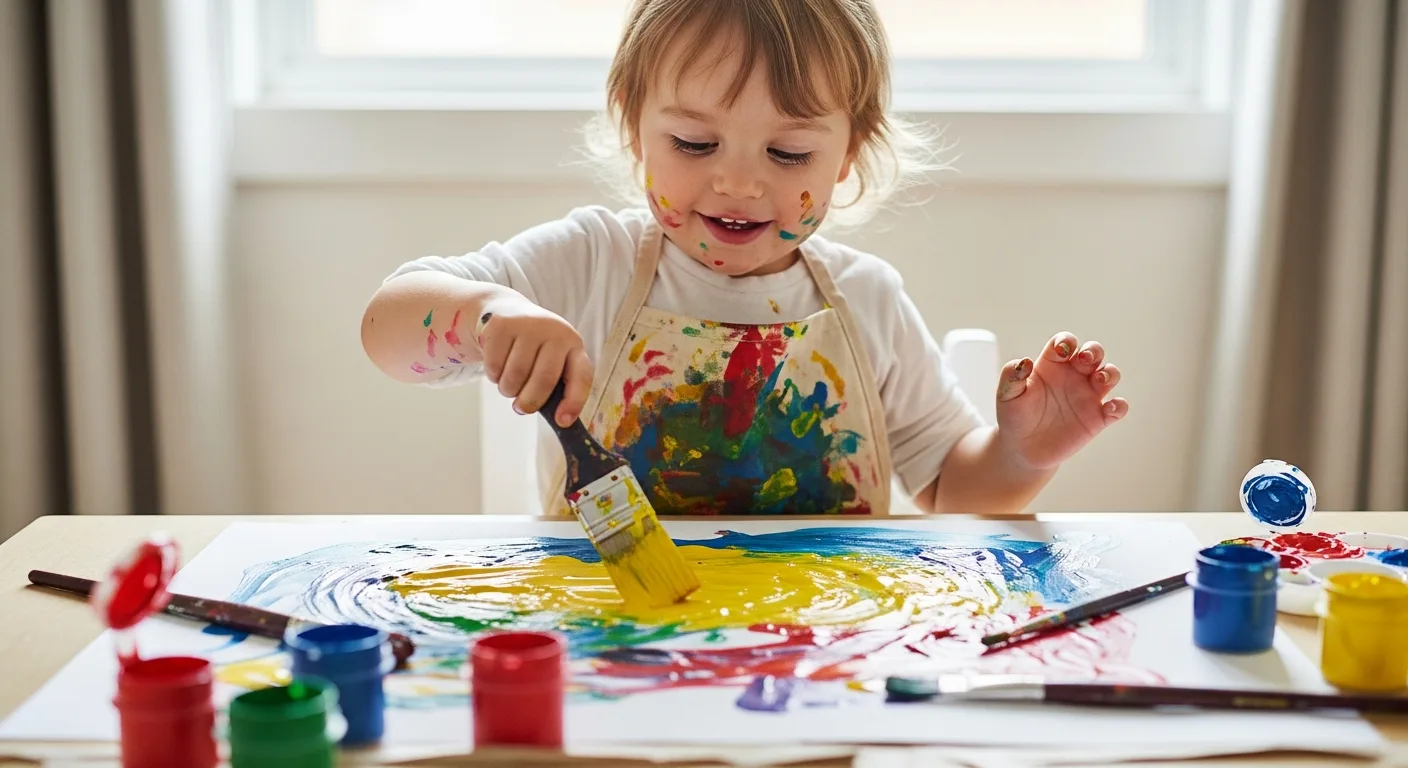
Set up paint and large paper — but instead of brushes, provide rollers, sponges, cotton reels, bubble wrap, and cardboard edges. The constraint of unfamiliar tools pushes creative thinking and produces visually rich results. There is no right outcome — the exploration is the entire point. This is process art at its purest: the experience, not the product, is what matters.
Loose parts collage on a light table
Arrange translucent and opaque loose parts — coloured acetate, natural items, fabric, tissue paper — on a light table or bright window and let your toddler compose freely. The light adds a visual dimension that transforms even simple arrangements into striking compositions. Change the materials regularly to keep the creative challenge fresh.
Watercolour resist with wax crayon
Draw or scribble on paper with a white or light wax crayon, then paint over with watercolour. The wax resists the paint and the hidden drawing is revealed. The surprise element makes this one of the most engaging art activities for toddlers — and the unpredictability teaches that creative exploration produces unexpected rewards.
Mud and clay sculpting outdoors
Natural clay from a garden centre, or simple mud from the garden, is one of the most creatively rich materials available. Squeezing, rolling, pinching, and shaping it builds tactile creativity alongside hand strength. Work outdoors with no agenda — simply provide the material and observe what emerges. Some toddlers make animals, some make containers, some make marks and textures. All of it is creative.
Collaborative large-scale art
Tape a full roll of paper to the floor or a low wall and create together with no plan. Brushes, rollers, fingers, stamps — all of it simultaneously. Collaborative art builds the understanding that creative work can be shared, that another person's marks add rather than diminish, and that the process of making is social as well as personal.
🎵 Music
Body percussion improvisation
Clap, stomp, pat, click, and snap — exploring rhythm using nothing but the body. Call and response works brilliantly: you make a pattern, your toddler copies it; then they make one and you copy theirs. This builds rhythmic awareness, working memory, and the understanding that music can come from anywhere — including yourself.
Homemade instrument orchestra
Stretch elastic bands of different thicknesses across a box to create a guitar. Fill sealed containers with different amounts of rice or lentils to make shakers with different sounds. Tap water-filled bottles with a spoon to create a xylophone. Making the instruments is part of the creative activity — then play them together.
Freeze dance with musical reflection
Play music and dance freely — then pause it and ask: 'How did that music make your body feel?' The pause and reflection moment turns a physical activity into an expressive one. Use different styles — slow classical, fast drumming, gentle folk, rhythmic pop — to generate genuinely different physical and emotional responses.
Sound mapping outdoors
Take a notebook and a pencil outdoors and sit quietly for five minutes. Draw a different mark for each sound you hear — birds, wind, passing cars, leaves. Compare your maps. This creative listening exercise builds auditory attention, symbolic representation, and a rich appreciation for the sonic environment that most children — and adults — overlook.
🎭 Drama
Small world imaginative play with found objects
A tray of natural materials — pebbles, sticks, leaves, moss — with a handful of small animals or figures creates a small world with no script. Your toddler invents the story, the characters, the conflicts, and the resolutions. Small world play is the richest form of self-directed drama available and typically produces the longest sustained play sessions of any toddler activity.
Character dress-up with minimal props
A single hat, one scarf, or a pair of oversized shoes is enough to transform a toddler into a character. The minimal prop is actually more creative than an elaborate costume — it requires the imagination to fill in the rest. Introduce new props regularly: a doctor's bag, a crown, a magic wand made from a stick.
Puppet theatre with paper bag puppets
Glue a face onto a paper bag, or draw one onto a sock, and put on a show. The puppet provides creative distance — toddlers who are shy about performing directly will express themselves freely through a character. The stories that emerge through puppet play often reveal emotional themes that toddlers are working through internally.
📖 Storytelling
Dictated story books
Ask your toddler to tell you a story and write it down exactly as they say it — without editing or improving. Then read it back to them, exactly as told, with full seriousness. Illustrate it together. This activity is transformative for narrative confidence: toddlers discover that their stories are real, valuable, and worth keeping.
Story stones with loose characters
Paint simple characters, settings, and objects onto smooth stones — a child, a dragon, a forest, a castle, a dog. Pile them in a bag, draw one out at a time, and build a story as each new stone is revealed. The constraint of the stones pushes creative narrative decisions in unexpected directions.
Wordless picture book improvisation
Share a wordless picture book — or a picture book read many times before — and this time, ask your toddler to tell the story while you listen and write. The existing images provide creative support without constraining the narrative. What emerges is almost always more inventive than the original text.
For creative activities that also build fine motor precision, our fine motor skill activities for toddlers guide has a range of art and craft-based ideas specifically designed for hand strength and control development.
Frequently Asked Questions
What is open-ended creative play for toddlers?
Open-ended creative play is any play where there is no single correct outcome — no kit to complete, no picture to copy, no instruction to follow. The toddler decides what to make, how to use the materials, and what it means. Art, music exploration, drama, and storytelling are the four main forms. Open-ended play is the most developmentally rich type of play available because it demands imagination, decision-making, and flexible thinking simultaneously.
At what age should toddlers start creative play?
Creative play can begin as soon as a child can safely interact with materials — from around 12 months for simple sensory art (finger painting, water play) and music exploration. By 18 months most toddlers engage enthusiastically with open-ended materials. Drama and storytelling elements emerge from around 2 years as symbolic thinking develops. There is no age that is too early to begin, provided materials are safe and appropriate.
Is creative play more important than structured learning for toddlers?
For toddlers under four, open-ended creative play is arguably more developmentally valuable than structured learning activities. The cognitive demands of creative play — divergent thinking, planning, self-regulation, perspective-taking — are exactly the skills that prepare the brain for structured learning later. Research consistently shows that toddlers with rich creative play histories outperform peers in language, problem-solving, and social skills by school age.
How do I set up a creative play space without spending a lot?
The best creative play spaces use the simplest materials. A low table or tray on the floor, a collection of open-ended materials (cardboard, fabric scraps, natural items, recycled containers), basic art supplies (crayons, washable paint, glue), and a few musical instruments (shakers, drums, or homemade versions) are all you need. The space should be accessible independently — low shelves, items within reach — and tolerant of mess, which often means a wipe-clean surface and a splat mat under art activities.
My toddler always wants me to play with them. Should I step back during creative play?
Joining is wonderful — but how you join matters enormously. Sit alongside and create your own thing rather than directing or improving their work. Comment on what you notice rather than asking 'what is it?' — 'I see you used lots of swirling lines' is more powerful than 'what did you make?' The goal is to be a companion in the creative space rather than an instructor. As your toddler builds confidence, they will gradually need your physical presence less and sustain independent creative play for longer stretches.
Looking for more toddler activity ideas?
Try our Toddler Activity Generator for instant indoor and outdoor ideas matched to your toddler's age.
Try the Toddler Activity Generator