
Cognitive Development Activities for Toddlers: Sorting, Memory and Thinking Skills by Age
Between the ages of one and four, a toddler's brain develops faster than it ever will again. The experiences available during this window don't just fill time — they literally build the neural architecture that determines how a child will think, learn, and reason for the rest of their life. The most powerful activities for this period are not academic lessons. They are precisely targeted cognitive challenges — sorting, categorising, cause-and-effect play, memory games, and comparison thinking — delivered through hands-on, self-directed play.
This guide covers 15 specific cognitive development activities for toddlers, organised by age group — from the cause-and-effect foundations of 12 to 18 months through to the complex sorting and comparison thinking of three to four years. Plus: what strong cognitive development looks like at each stage, and how to observe meaningful progress at home.
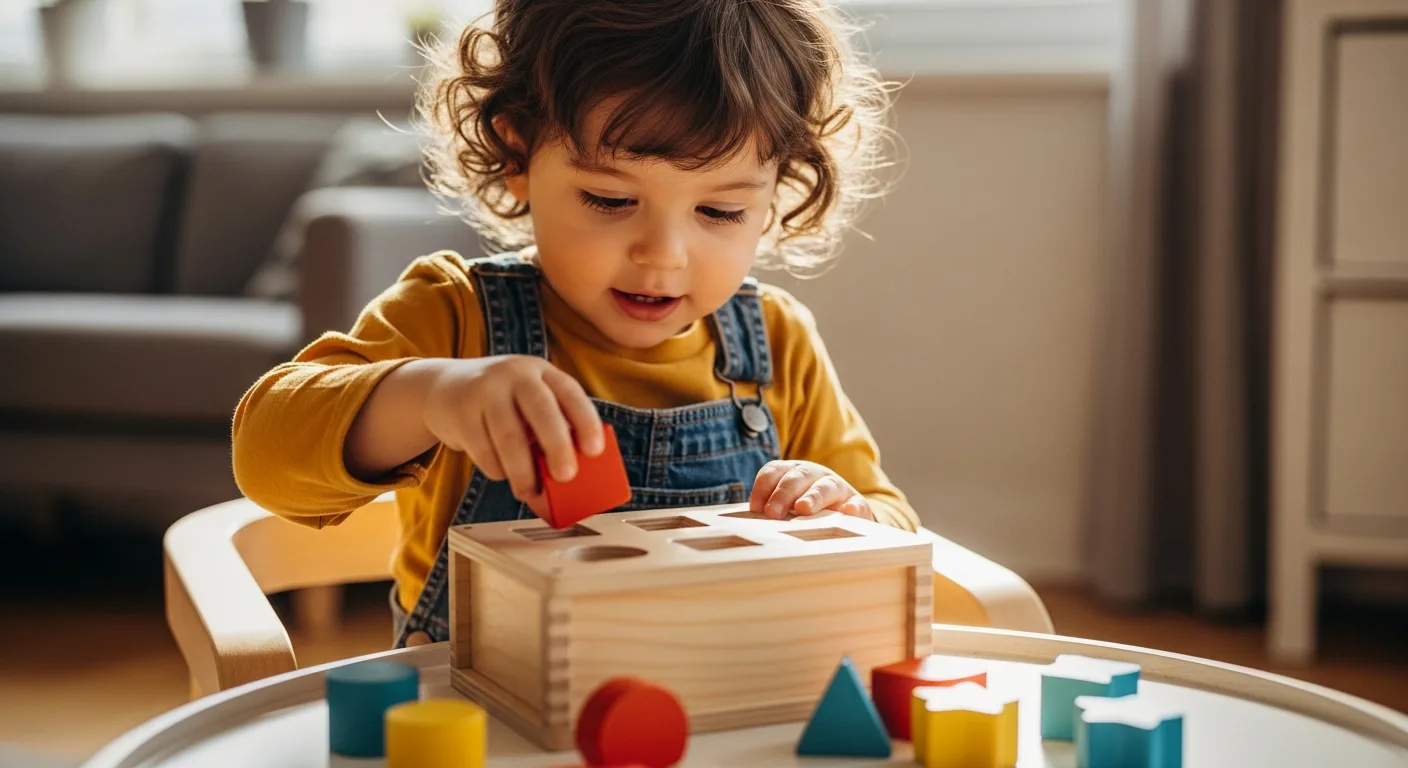
The Five Core Areas of Toddler Cognitive Development
These five cognitive skills underpin everything that follows — reading, mathematics, science, social understanding, and self-regulation. They develop simultaneously and interdependently through the same kinds of play experience.
Working memory
Holding information in mind while using it. Essential for following instructions, solving problems, and — later — reading comprehension and mental arithmetic.
Attention and concentration
Sustaining focus on a task long enough to complete it. The foundation of all learning. Built through self-chosen, intrinsically motivating play — not through externally directed instruction.
Categorisation and sorting
Organising the world into groups with shared properties. The cognitive foundation of vocabulary, maths, and scientific classification. Begins at around 18 months with single-attribute sorting.
Cause-and-effect understanding
Predicting consequences of actions. Built through physical exploration — pouring, dropping, stacking — and refined through prediction games and scientific experiments.
Symbolic thinking
Understanding that one thing can represent another. Underpins language (words represent objects), maths (numbers represent quantities), reading (letters represent sounds), and all forms of pretend play.
15 Cognitive Development Activities by Age
These activities are targeted at the specific cognitive skills that are developmentally primed at each age. Presenting activities that are too advanced creates frustration without learning; activities that are too simple provide no cognitive challenge. The age groupings are approximate — observe your individual toddler and adjust accordingly. For a broader view of how these cognitive skills connect to overall learning, our learning through play at home guide has the full developmental picture.
12–18 Months: Cause and Effect Foundations
At this age the priority is building the most fundamental cognitive concept: that actions have predictable, repeatable consequences. Simple, high-contrast cause-and-effect is the entire curriculum.
Drop and retrieve games
Drop objects into containers, remove them, repeat. The predictability of the consequence — it goes in, it comes out — is exactly the cognitive cause-and-effect loop this age needs. Vary the container sizes and object shapes.
Simple push-button cause and effect toys
Press the button, the sound plays. Press again, the same sound. The repeatability is not boredom — it is the neural pathway being cemented. Allow as many repetitions as the toddler requests.
Stacking and knocking down
Build a tower; knock it over. The satisfaction of knocking down is not destructive impulse — it is the confirmation of predicted cause and effect. Your toddler is a scientist testing a hypothesis, every time.
Water pouring between containers
Two containers and water teaches volume, flow, and the cause-effect relationship between pouring angle and what happens. Supervised water play at 12 months is cognitively richer than almost any toy purchase.
18 Months–2 Years: Sorting and Categorisation
Between 18 months and two years, the brain is ready for the next cognitive leap: organising the world into categories. Sorting by one attribute — colour, shape, or size — becomes both achievable and deeply satisfying.
Colour sorting with household objects
Gather coloured household objects — buttons, blocks, socks, kitchen items — and sort into matching coloured containers. Name the category as you sort: 'These are all the red ones.' Sorting by one attribute is the target skill; two attributes comes later.
Big and small sorting
Collect objects of clearly different sizes and sort them into two groups: big and small. The binary classification is cognitively manageable at this age and builds the concept of relative size that maths later depends on.
Shape posting with a shape sorter
Classic shape sorters remain excellent cognitive tools at this age. The visual discrimination required to match shape to hole, and the spatial reasoning needed to orient the shape correctly, are genuine cognitive challenges.
Animal vs food category bins
Print or cut out pictures of animals and food. Sort them into two labelled bins. Category formation — understanding that objects belong to abstract groups — is one of the foundational cognitive skills this age is primed to develop.
2–3 Years: Memory, Attention, and Problem Solving
At two, working memory is expanding rapidly and attention spans are growing. Activities that hold information in mind while acting on it — and that require planning and problem-solving — are the right challenge level.
What's missing? working memory game
Lay three familiar objects on a tray. Ask your toddler to look carefully, cover the tray, remove one object, uncover. What's missing? Start with three objects and work up to five as skill grows. Direct working memory training.
Simple two-to-three piece sequencing
Three-picture sequencing cards — showing a familiar process like planting a seed, watering it, and a flower growing — build causal reasoning and narrative sequencing simultaneously. Describe what is happening at each step.
Four-pair memory card matching
Face four pairs of cards down, turn two over at a time, find the match. Four pairs is achievable by most two-year-olds with practice. Working memory, pattern recognition, and attention are all engaged.
Simple puzzle completion (6–12 pieces)
Puzzles at this age require visual discrimination, spatial reasoning, and the executive function skill of holding the target image in mind while selecting pieces. The frustration tolerance required is also a genuine cognitive benefit.
3–4 Years: Complex Sorting, Prediction, and Comparison
By three, sorting by two attributes, making complex predictions, comparing and measuring, and building extended narratives are all within reach. The cognitive activities at this stage feel more like early academic learning — while remaining rooted in play.
Sort by two attributes simultaneously
Sort objects that are red AND round, blue AND square. Two-attribute sorting requires holding two rules in mind simultaneously — a significant executive function demand that represents a major cognitive leap from single-attribute sorting.
Prediction in shared reading
Before turning each page: 'What do you think happens next?' At this age, predictions become more sophisticated — drawing on narrative knowledge, character understanding, and prior story experience rather than pure guessing.
Non-standard measuring activities
How many handprints long is the table? How many blocks tall is the bookshelf? Non-standard measuring introduces measurement concepts and comparative language (longer, shorter, more, fewer) before the precision of rulers and numbers is introduced.
Same and different comparison discussions
'How are these two animals the same? How are they different?' Comparison thinking — systematic analysis of shared and distinct attributes — is one of the highest-order cognitive skills available at this age and transfers directly to reading comprehension and scientific thinking.
Signs of Strong Cognitive Development at Each Stage
These are observational markers — things to notice during everyday play rather than formal tests. Wide individual variation is completely normal within each age band.
By 18 months
Completes simple inset puzzles (2–3 pieces), shows clear cause-effect understanding, begins sorting objects into two groups, follows one-step instructions reliably.
By 2 years
Sorts objects by one attribute (colour or size), sustains attention for five to eight minutes on chosen activity, engages in simple pretend play, can recall very recent events.
By 3 years
Sorts by two attributes, counts up to five with one-to-one correspondence, understands basic time concepts (yesterday, tomorrow), sustains attention for ten to fifteen minutes, makes predictions in familiar contexts.
By 4 years
Sorts by multiple attributes, understands that some things can belong to more than one category, can plan a simple multi-step activity, uses language to reason ('because', 'so that', 'what if').
How to Measure Cognitive Progress at Home
The most useful home measurement tool is a simple observational approach: note what your toddler can do independently that they needed help with last month. Cognitive progress in toddlers shows up as:
- Longer sustained attention on chosen activities without adult prompting
- More complex sorting — moving from one attribute to two attributes
- More accurate predictions before events ("I think it will fall")
- Longer and more coherent narrative sequences in play and storytelling
- Spontaneous use of comparative language (bigger, heavier, more, fewer)
- More independent problem-solving before requesting adult help
For activities that build the thinking skills that feed into early maths and science, our educational games for toddlers guide goes deeper on game-based cognitive development. And for activities that build the spatial reasoning and fine motor skills that support cognitive work, see our fine motor skill activities for toddlers guide.
Frequently Asked Questions
What are the main areas of cognitive development in toddlers?
The five main areas of cognitive development in toddlers are: working memory (holding and using information in mind), attention and concentration (sustaining focus on a task), categorisation and sorting (grouping objects by shared properties), cause-and-effect understanding (predicting consequences of actions), and symbolic thinking (understanding that one thing can represent another, which underlies language, maths, and reading). All five develop simultaneously through hands-on, self-directed play.
How can I tell if my toddler's cognitive development is on track?
Signs of strong cognitive development by age two include: sorting objects by one attribute (colour or size), completing simple three-to-four piece puzzles, understanding basic cause and effect (pressing a button makes a sound), following two-step instructions, engaging in simple pretend play, and showing curiosity about how things work. By three, most toddlers can sort by two attributes, recall recent events, count up to five with one-to-one correspondence, and sustain attention for ten to fifteen minutes on a chosen activity. Wide individual variation is entirely normal.
How much time should toddlers spend on cognitive activities each day?
There is no prescribed daily quota for cognitive activities — because for toddlers, the distinction between 'cognitive activity' and regular play is largely artificial. Sorting, categorising, predicting, and experimenting happen naturally across all play contexts. What matters more than timed activity sessions is the quality of the environment: access to diverse materials, uninterrupted play time, and an adult who asks open questions and follows the child's curiosity rather than imposing a curriculum.
Are some toddler toys better for cognitive development than others?
Open-ended materials consistently outperform closed-ended (single-use) toys for cognitive development. Blocks, loose parts, clay, simple puzzles, and sorting materials require the child to think, plan, and problem-solve — generating far more cognitive demand than toys that do the work for the toddler (lights, sounds, automated responses). The best cognitive toy investment is almost always the least specific: a set of blocks and a collection of varied natural materials outperform any electronic learning toy.
Can I measure my toddler's progress in cognitive development at home?
At home, the most useful form of progress tracking is observational rather than test-based. Note what your toddler can do this month that they could not do last month: Can they sort by two attributes now when they could only manage one before? Are they sustaining attention longer? Making more complex predictions? Engaging in multi-step pretend play? These observations are meaningful progress indicators. If you have specific concerns about developmental delay, a conversation with your health visitor or paediatrician is always worthwhile — they use validated assessment tools that home observation cannot replicate.
Looking for more toddler activity ideas?
Try our Toddler Activity Generator for instant ideas matched to your toddler's age and development stage.
Try the Toddler Activity Generator