
STEM Activities for Toddlers
STEM — Science, Technology, Engineering, and Mathematics — sounds like something that belongs in a classroom, not on a kitchen table with a two-year-old. But toddlers are natural STEM learners. Every time they pour water, knock down a tower, or wonder why the ice cube disappeared, they are doing science. Every time they build something and watch it fall, they are doing engineering.
The 15 STEM activities for toddlers in this guide require no specialist equipment, no formal setup, and no curriculum. They are simple, playful, and genuinely fascinating for curious young minds — and most of them happen in the middle of an ordinary day.
What STEM Means for Toddlers
At the toddler stage, STEM is not about equations, coding, or technical knowledge. It is about cultivating the mindset and habits of a scientist and engineer: curiosity, observation, experimentation, persistence in the face of failure, and the willingness to try a different approach when the first one does not work.
Science
Observing and exploring the natural world
Technology
Using and understanding tools
Engineering
Building, designing, and solving physical problems
Maths
Counting, comparing, and recognising patterns
Your Daily Routine Is Already Full of STEM
This is the unique insight most parents miss: you do not need to schedule STEM activities. Your toddler's ordinary day is already full of them — they just need to be noticed and gently extended.
Bath time
Chemistry and physics — why does soap make bubbles? Why do some toys float and others sink?
Cooking together
Measurement, heat, and change of state — why does bread rise? Why does ice melt in the bowl?
A walk outside
Biology and earth science — noticing seasons, spotting insects, observing cloud shapes
Laundry
Sorting, categorising, and counting — matching socks is mathematics in disguise
Watering plants
Biology and cause-and-effect — what do plants need? What happens if we forget to water?
Why STEM Play Matters Early
Research consistently shows that early exposure to STEM thinking — through hands-on exploration — builds the neural pathways for logical reasoning, spatial awareness, and systematic thinking. It also builds scientific confidence: the belief that you can figure things out through trying, observing, and adjusting. This confidence is one of the strongest predictors of later engagement with STEM subjects. For the broader context of how play drives all learning, our Learning Through Play at Home guide is an excellent companion resource.
15 Simple STEM Activities for Toddlers
Science Experiments
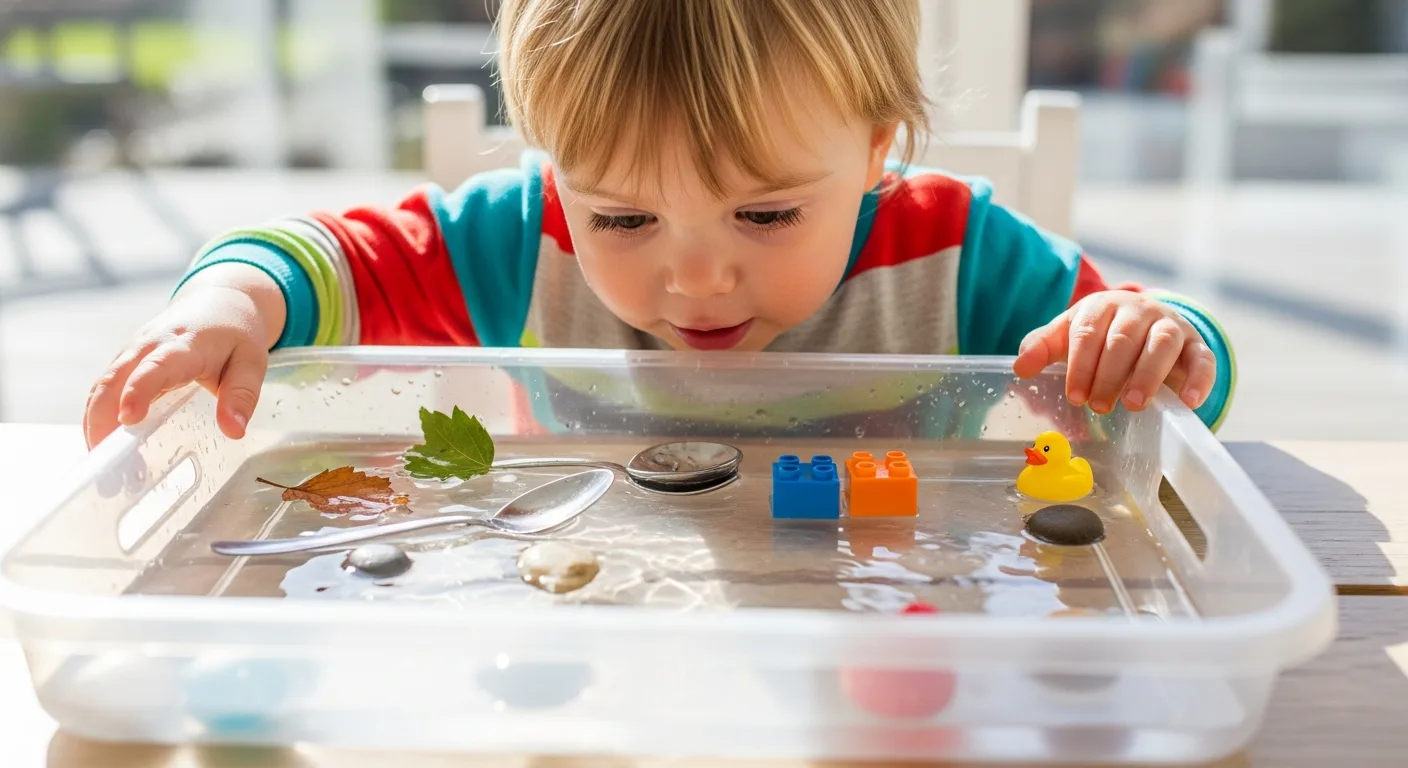
Sink or float investigation
Fill a large bowl or the bath with water and collect a range of small objects — a rubber duck, a stone, a cork, a metal spoon, a leaf. Predict together whether each will sink or float, then test. This is direct experimental science: observe, predict, test, reflect.
Mixing bicarb and vinegar
Put a spoonful of bicarbonate of soda into a bowl and let your toddler add drops of vinegar with a pipette. The fizzing reaction is genuinely dramatic and endlessly repeatable. Use food colouring to make it visually exciting. This is chemistry — a real chemical reaction, observed and caused by a toddler.
Ice melting investigation
Freeze some small toy animals in ice cubes overnight. The next day, give your toddler the ice and different tools for freeing them — warm water, salt, their hands — and observe what works fastest. Time, temperature, and physical change in one irresistible activity.
Shadow tracing
On a sunny day, place a toy or object on paper and trace its shadow. Move the paper at different times of day and observe how the shadow changes. This is optics and earth science — light, angle, and time — all from a stick and some paper.
Magnetic exploration
Give your toddler a fridge magnet and let them move around the house testing what sticks and what does not. The sorting into 'magnetic' and 'not magnetic' categories adds a cognitive layer to the physical exploration.
Engineering Challenges
Building a bridge over a gap
Set up two stacks of books with a gap between them and provide a range of materials — lolly sticks, cardboard, blocks, fabric. Challenge your toddler to build a bridge that can hold a toy car. This is pure engineering: design, build, test, revise.
Tower height challenge
Provide a collection of mixed materials — blocks, cardboard tubes, empty boxes — and challenge: can you build the tallest tower? What happens when it falls? What could we do differently? The design-build-test-revise cycle is the engineering process in miniature.
Ramp building and car racing
Prop a piece of cardboard or a plank against a box to create a ramp. Roll toy cars or balls down and observe: which goes further? What happens if the ramp is steeper? This is elementary physics — angle, gravity, speed — experienced through play.
Maths and Measurement
Weighing and comparing on a balance scale
A simple balance scale — or a ruler balanced on an eraser — lets toddlers directly compare weights. Which is heavier: the apple or the block? Add and remove objects and observe what happens. This is direct mathematical measurement through physical experience.
Capacity and volume with water pouring
Provide containers of different sizes and a jug of water. How many small cups fill the big jug? Which container holds the most? This direct hands-on experience with volume and capacity builds mathematical intuition long before formal measurement is introduced.
Shape exploration with 3D objects
Collect cylinders, cubes, spheres, and cones from around the house. Which ones roll? Which ones stack? Which ones slide? Exploring the physical properties of 3D shapes connects geometry to physical discovery. Our <Link href='/blog/shape-activities-for-toddlers' className='text-primary font-semibold hover:underline'>Shape Activities for Toddlers</Link> guide has more ideas in this area.
Nature and Observation
Growing seeds in a transparent pot
Plant a bean seed against the side of a clear plastic cup filled with damp kitchen paper. Observe the root growth, shoot emergence, and daily changes. Keep a simple picture record. This is biology: life cycles, growth, and observation over time.
Exploring with a magnifying glass
Hand your toddler a large-handled magnifying glass and go outside. What does bark look like up close? A leaf? A pebble? A worm? The magnifying glass is a science tool that transforms the familiar into something extraordinary.
Wind and air exploration
On a windy day, give your toddler materials of different weights — a feather, a piece of foil, a heavy stone — and explore which the wind moves. Indoors, use a straw to blow objects across a table. Air is invisible but its effects are real and explorable.
Simple coding with positional language
Create a 'robot path' game: give your toddler directional instructions — forward two steps, turn right, forward one step — to navigate from a start to a finish. This is early computational thinking: sequence, instruction, and direction, without a screen.
Easy Materials to Keep at Home
Water
Salt and bicarb
Vinegar and lemon juice
Cardboard boxes
Fridge magnets
Magnifying glass
Mixed containers
Seeds and soil
Balance scale
Looking for more toddler activity ideas?
Try our Toddler Activity Generator to instantly get indoor and outdoor ideas based on your toddler's age.
Try the Toddler Activity GeneratorFrequently Asked Questions
What age can toddlers start STEM activities?
From around 12 months, toddlers can engage in simple STEM concepts through sensory play, water pouring, and object exploration. The activities become more intentional and structured from 18 months onwards, as language and reasoning develop. Most of the activities in this guide are suitable for toddlers aged 18 months to 4 years, with adaptations for age.
Do I need to buy expensive STEM kits or toys?
Not at all. The best STEM activities for toddlers use things you already have at home: a bowl of water, cardboard boxes, bicarbonate of soda, seeds, a magnifying glass, containers of different sizes. Expensive STEM kits are rarely more effective than these simple household setups for children under four.
How do I know if a STEM activity is too advanced for my toddler?
The clearest sign is consistent frustration or disengagement within the first minute or two. A good STEM activity should produce curiosity and exploration, not stress. If an activity is too advanced, simplify it: reduce the number of steps, use larger or more manageable materials, or demonstrate the first step together before stepping back.
How long should STEM activities last with toddlers?
For most toddlers, 10 to 20 minutes is a full STEM session. Younger toddlers may engage for as little as 5 minutes on a single activity. The key is to end the session while your toddler is still interested — this leaves them wanting to return to the activity, which is exactly the scientific disposition you want to build.
My toddler just wants to splash the water rather than do the 'experiment'. Is that okay?
Absolutely — free exploration IS the scientific method at the toddler stage. The splashing, pouring, tipping, and discovering through their own investigation is exactly what builds the observation skills and physical intuition that formal STEM thinking draws on later. Follow their lead rather than redirecting them to a specific outcome.
Final Thoughts
STEM activities for toddlers are not about raising future scientists — they are about cultivating the habits of mind that serve children across every area of life: curiosity, systematic thinking, persistence, and the confidence to try things without knowing the answer in advance.
Every bridge that falls, every ice cube that melts, every seed that sprouts is a lesson in observation, patience, and cause and effect. You do not need a laboratory. You need a willing toddler and a few things from the kitchen cupboard. For more play-based learning ideas, explore our Cognitive Development Activities for Toddlers and Problem Solving Games for Toddlers.