
Authentic Montessori Activities for Toddlers: Practical Life, Sensorial, Language and Math by Age
"Montessori" has become one of the most overused words in parenting. It appears on toy packaging, activity books, YouTube channels, and Instagram grids — often attached to things that have little to do with what Maria Montessori actually developed over a lifetime of observation and research. This guide is about authentic Montessori: what the four curriculum areas actually are, what they look like at home with a toddler, and how to implement them without a specialist classroom or expensive materials.
The 15 activities below are organised by the four authentic Montessori curriculum areas — practical life, sensorial, language, and mathematics — and by age group from 15 months to 4 years. Each includes the materials needed and what the activity is actually building developmentally.
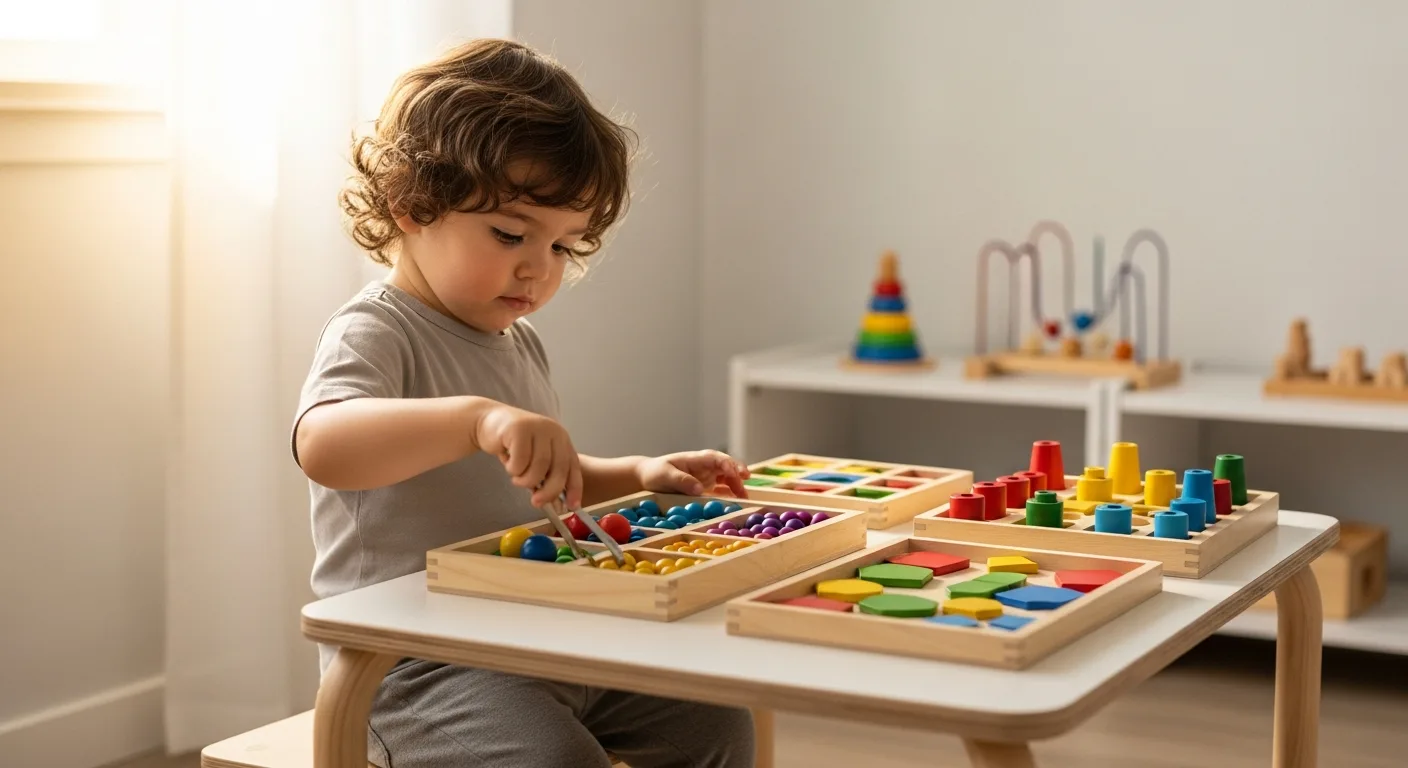
The Four Authentic Montessori Curriculum Areas
In an authentic Montessori environment, all activity falls into four areas. Understanding these areas is the difference between genuine Montessori and activities that simply use the word:
Practical Life
Real, meaningful everyday tasks — pouring, spooning, folding, cleaning, food preparation. These feel genuinely important to toddlers because they are genuinely important, and that authentic purpose produces the deep focus Montessori is known for.
Sensorial
Activities that isolate and refine specific senses — touch, weight, size, sound, smell. The classic Montessori sensorial materials (pink tower, colour tablets, sound cylinders) develop discrimination and classification skills that underpin later mathematical and scientific thinking.
Language
Rich vocabulary introduction using three-period lessons, classified picture materials, sandpaper letters for phonetic awareness, and the moveable alphabet for early composition. Language in Montessori is always real, precise, and introduced in context.
Mathematics
Concrete mathematical materials — number rods, spindle boxes, golden bead material — that make abstract numerical concepts physical and tangible. Montessori maths begins with quantity before symbol, always in three-dimensional, manipulable form.
How to Set Up a Montessori Environment at Home
The prepared environment is the foundation of Montessori learning. Without it, the activities remain isolated events rather than part of a coherent developmental framework.
Low, accessible shelving
A low shelf that a toddler can reach independently is the starting point. Activities live on trays on these shelves. The toddler chooses a tray, carries it to a mat or table, completes the activity, returns it. Independence is the structure.
Activity trays with complete materials
Each activity lives on a small tray with everything needed and nothing extra. A spooning activity tray has two bowls, a spoon, and the material to be transferred — nothing else. The container defines the activity and makes the clean-up obvious.
Order and rotation
Keep 6–8 activities available at once. Too many overwhelms; too few bores. Rotate every one to two weeks, retiring activities the toddler has fully mastered and introducing new challenges at the next developmental level.
Real materials, not replicas
Real glass (unbreakable Duralex is ideal), real ceramics, real metal tools. Real materials connect the toddler to genuine consequence — they break if mishandled, they work as real tools do. Plastic replicas remove the consequence and, with it, the motivation for care.
A place to work
A small mat (or a defined table area) that belongs to the toddler's work. Laying out the mat signals that work is beginning; rolling it up signals completion. The ritual of preparation and completion is part of the Montessori learning process.
15 Authentic Montessori Activities by Age and Curriculum Area
For more on how intentional play environments support all areas of development, our learning through play at home guide covers the research underpinning play-based learning. For the fine motor foundations that make Montessori practical life work achievable, see our fine motor skill activities for toddlers guide.
15–24 Months: Practical Life Foundations
Practical LifeAt this age, the primary focus is on simple, high-success practical life activities that build bilateral coordination, concentration, and the deep satisfaction of task completion.
Dry pouring between jugs
Materials: Two small pitchers, dried rice or lentils, tray
Fill one pitcher with a small amount of dried rice. Place both pitchers on a tray. Demonstrate a slow, controlled pour — show the starting position, the tipping, and the stopping — then invite your toddler to try. Repeat back and forth. The repetition is the learning; do not interrupt it.
Water pouring with sponge
Materials: Two small pitchers, small amount of water, sponge, tray
As above but with water, adding a small sponge for spills. The sponge normalises mistakes and adds a second purposeful task: mopping up is part of the activity, not a consequence of failure.
Spooning between bowls
Materials: Two small bowls, child-sized spoon, pom poms or small objects
Place pom poms or small objects in one bowl. Invite transfer, one at a time, using the spoon. This develops the tripod grip that later transfers to pencil control. Encourage slow, deliberate movement.
Peeling fruit
Materials: Banana, satsuma, or soft-skin fruit; small bowl
A banana is the ideal first peeling activity — the natural segments are intuitive for toddler fingers. A satsuma comes next. These activities develop finger strength, bilateral coordination, and the genuine satisfaction of food preparation.
18 Months–2.5 Years: Sensorial Exploration
SensorialThe sensorial activities of this period isolate a single quality — texture, weight, size, or sound — so the toddler's attention is fully focused on the discrimination being developed.
Rough and smooth sorting
Materials: Sandpaper pieces, smooth stones, velvet fabric, rough bark, tray with two sections
Introduce the language first, without sorting: 'This is rough. Feel it. This is smooth. Feel it.' Then invite sorting. The vocabulary introduction before the classification task is the Montessori three-period lesson in miniature.
Graduated size ordering
Materials: 5–6 nesting cups or boxes of graduated sizes
Present the cups in random order and invite ordering from smallest to largest in a line, then nesting. Size gradation — the concept that objects relate to each other by relative size — is a foundation of mathematical thinking.
Sound cylinders
Materials: 6 pairs of small containers filled with different amounts of the same material (rice, sand, small pebbles)
Shake and match pairs by sound. This is the Montessori sound cylinder activity in homemade form. The auditory discrimination required is a genuine cognitive challenge and a foundation for musical and phonological awareness.
Fabric texture matching
Materials: Pairs of small fabric squares: silk, cotton, velvet, denim, wool, linen
With eyes open then closed, match pairs of fabrics by touch. The tactile discrimination isolates the sense of touch in a way that requires genuine focused attention.
2–3 Years: Language Materials and Vocabulary
LanguageBetween two and three, toddlers are in a sensitive period for vocabulary and the beginning of phonetic awareness. Montessori language work at this stage is about precision, richness, and connecting language to real experience.
Three-period vocabulary lessons with objects
Materials: Three related real objects (e.g., three leaf types, three fruit, three animals)
Period 1: 'This is an oak leaf. This is a maple leaf. This is a sycamore leaf.' Period 2: 'Show me the oak leaf.' (point, hand, carry). Period 3: 'What is this?' (name it). Three-period lessons build precise vocabulary from real objects, not pictures or flashcards.
Classified picture cards
Materials: Sets of classified picture cards: animals, foods, vehicles, tools (Montessori sets or DIY from magazines)
Match pictures, sort into categories, name each. The precision of classification — these are all mammals, these are all reptiles — develops both vocabulary and the logical thinking that underlies taxonomy and science.
Sandpaper letter tracing (phonetic sounds)
Materials: Sandpaper letters (individual letters on cards, rough letter surface on smooth background)
Trace the letter shape with two fingers while saying its phonetic sound — not its name. 'm' not 'em'. The tactile-auditory-visual combination is the Montessori approach to phonics: three senses encoding the same information simultaneously.
Story basket with real objects
Materials: A small basket of real objects that tell a simple story (e.g., a stone, a leaf, a small animal figure, a piece of string)
Arrange the objects and tell a story using them as props. Then invite your toddler to tell a story with the same objects. The real, tangible objects ground the narrative language in physical experience.
2.5–4 Years: Early Mathematics in Concrete Form
MathematicsMontessori maths begins with physical quantity before abstract symbol. All mathematical concepts at this age are introduced with real, manipulable objects that make the abstract concrete.
Number rods or number line
Materials: 10 rods of graduated lengths (or a homemade version with strips of card cut to 10cm, 20cm... 100cm increments)
Order from shortest to longest, counting the segments as you lay each rod. The physical comparison of 'one' versus 'ten' — felt in the hands and seen across the table — builds number sense more powerfully than counting alone.
Counting with moveable objects
Materials: Numbered cards 1–5, collection of small objects
Place a numbered card on the table. Count out the exact number of objects and place them beside the card. This one-to-one correspondence — one object, one count — is the foundation of all mathematical reasoning.
Sorting by quantity (more and fewer)
Materials: Two containers, collection of small objects in different quantities
Sort into 'more' and 'fewer' and compare: 'This pile has more. This pile has fewer.' Comparative quantity language — foundational to maths — begins with physical, visible, countable quantities.
Bead threading by colour pattern
Materials: Wooden beads in primary colours, threading lace or pipe cleaner
Create a simple alternating pattern — red, blue, red, blue — and invite your toddler to continue it. Then introduce a two-step pattern: red, red, blue. Patterning is the cognitive foundation of algebraic thinking and mathematical sequencing.
For activities that complement Montessori work by building the cognitive skills of sorting, categorisation, and working memory, our cognitive development activities for toddlers guide goes deeper on thinking skills by age.
Frequently Asked Questions
What does authentic Montessori mean for toddlers at home?
Authentic Montessori at home means three things above all else: (1) A prepared environment — materials available at the child's level, accessible independently, arranged with order and purpose. (2) Freedom within limits — the toddler chooses activities freely within a range of appropriate options, rather than being directed. (3) Real work with real materials — practical life activities using actual household objects, not plastic replicas, because toddlers are motivated by genuine purpose. Buying a Montessori toy set is not Montessori. Letting your toddler pour real water from a real pitcher and wipe up real spills with a real cloth — that is Montessori.
What age is Montessori appropriate for toddlers?
Montessori principles apply from birth, but the practical life activities most commonly associated with Montessori toddler work become richest between 15 months and 3 years. This aligns with what Maria Montessori identified as sensitive periods for movement, order, and language — windows of heightened developmental receptivity where specific types of experience have disproportionate impact. The 18-month to 3-year window is particularly powerful for practical life activities, sensorial exploration, and early language materials.
Do I need to buy expensive Montessori materials?
No. The most powerful Montessori activities for toddlers use everyday household objects: real pitchers for pouring, real bowls for spooning, real cloths for folding, real plants for watering. The Montessori materials that command high prices — pink tower, knobbed cylinders, sandpaper letters — are classroom tools designed for specific educational purposes. At home, the practical life curriculum is almost entirely achievable with what you already own. What you do need to invest is time, intention, and the preparation of an accessible, ordered environment.
How is Montessori different from other toddler learning approaches?
The most significant differences between Montessori and other early childhood approaches are: (1) The role of the adult — in Montessori, the adult prepares the environment and observes, rather than directing or instructing. (2) The materials — Montessori uses real, purposeful objects rather than toys, and specifically designed didactic materials rather than random play resources. (3) The goal — Montessori explicitly aims for independence and intrinsic motivation rather than compliance or performance. (4) The concept of 'work' — Montessori views the child's activity as genuine cognitive and physical work deserving of respect, not play to be managed.
How do I set up a Montessori environment on a budget?
A budget Montessori environment requires four things: (1) Low, accessible shelving — an IKEA KALLAX unit on its side creates perfect low shelving for activity trays. (2) Small trays — use any shallow tray, wooden board, or even a placemat to define activity spaces. (3) Real household tools at child scale — a small pitcher, a real cloth, a child-sized broom and dustpan. (4) Order and rotation — keep only 5–8 activities available at once, rotate regularly to maintain interest. The budget is in the simplicity — the most powerful Montessori activities cost nothing except intentional preparation.
Looking for more toddler activity ideas?
Try our Toddler Activity Generator for instant indoor and outdoor ideas based on your toddler's age.
Try the Toddler Activity Generator