
Memory Games for Toddlers: 20 Fun Ideas That Boost Brain Development
My daughter was two and a half when she corrected me on something that happened three weeks earlier. The detail was specific. She was right. I was genuinely stunned. Toddlers' memory capacity far exceeds what most parents expect — and memory games for toddlers are one of the most powerful ways to turbocharge that natural ability during the window when the brain is developing fastest.
These 20 memory games are organised by age and ability — from simple object-hiding games for 12-month-olds to multi-step instruction games for 3–4 year olds. Each one is backed by developmental science, requires minimal equipment, and — most importantly — actually works with real toddlers who have real attention spans.
For more learning activity ideas, the cognitive development activities for toddlers guide covers the broader landscape of brain-building play, and the educational games for toddlers post has more structured learning ideas across all developmental areas.
Why Memory Games Are Important for Toddlers
Memory is not a fixed trait — it is a skill that develops through use. The toddler years (ages 1–4) represent a critical window for memory development, when the brain is building the neural architecture for working memory, long-term storage, and recall strategies that will be used for the rest of life. Memory games for toddlers provide the specific, targeted stimulation those systems need to develop optimally.
Different memory games exercise different memory systems — visual, auditory, tactile, verbal, and sequential — and a varied diet of games across all of these is more valuable than intensive repetition of a single type. Here is what regular memory play actually develops:
Brain development and working memory
Working memory — the ability to hold and manipulate information in mind briefly — is one of the strongest predictors of academic achievement. Research consistently shows that children who play memory games regularly demonstrate stronger working memory capacity than peers who do not.
Concentration and focus
Memory games require sustained, directed attention. A toddler who regularly plays games that demand focus for 5–10 minutes is building the attentional capacity needed for all later learning — not as an incidental side effect, but as a direct result of the task structure.
Language development
Verbal memory games specifically build phonological memory — the ability to hold sound sequences in mind — which is the cognitive foundation of early reading. Toddlers with stronger phonological memory consistently show better outcomes in early literacy.
Social skills
Many memory games are inherently social: turn-taking, celebrating each other's successes, and the shared experience of a cooperative game all build social-emotional skills alongside cognitive ones. The best memory games feel like play because they are — the development is a bonus.
When Can Toddlers Start Playing Memory Games?
Earlier than most parents expect. Even very young toddlers can engage with age-appropriate memory activities — the key is matching the complexity of the game to the developmental stage. Here is a breakdown by age:
Signs your toddler is ready for memory games
- ✓They can follow your gaze and look where you point
- ✓They search for a toy that has been hidden from view
- ✓They can match at least two identical objects by sight
- ✓They sustain attention on a single activity for 2–3 minutes
- ✓They show interest in repetitive cause-and-effect play
20 Memory Games for Toddlers
These 20 memory games for toddlers are organised into three tiers by age and complexity. Start at the right tier for your toddler and move up as their confidence grows. For hands-on activity ideas that support cognitive development more broadly, the problem-solving activities for toddlers guide pairs well with the games below.
Ages 1–2Simple Memory Games
1. Peek-a-boo with a twist
12–18 monthsWhat you need: A light blanket or cloth
How to play: Hide a favourite toy under a blanket while your toddler watches, wait 5 seconds, and ask 'Where did it go?' Let them lift the blanket to find it. Gradually increase the delay before they search.
Why it helps: This is the foundational memory game for the youngest toddlers, directly exercising object permanence — the understanding that things exist even when not visible. It is the bedrock all other memory skills build on.
2. Which cup is hiding the toy?
12–24 monthsWhat you need: 3 opaque cups, 1 small toy
How to play: Show your toddler a small toy, hide it under one of three cups, slide the cups slowly, and ask them to find it. Celebrate enthusiastically every find.
Why it helps: Tracking a hidden object through movement is a more demanding visual memory task than static hiding games. It builds spatial memory and visual tracking simultaneously.
3. 2-pair animal matching
14–24 monthsWhat you need: 4 matching picture cards (2 pairs)
How to play: Lay 4 cards face up — no hiding yet — and ask your toddler to find the two that are the same. Once they reliably match face-up cards, flip them face down and begin the classic memory format.
Why it helps: Face-up matching builds visual discrimination and the concept of 'same.' It is the developmental bridge between simple identification and true memory matching.
4. Body part point-and-remember
12–18 monthsWhat you need: Nothing
How to play: Point to a body part on yourself, name it, then after a 3-second pause ask your toddler to point to the same part on themselves. Gradually extend the delay.
Why it helps: This is a toddler-friendly working memory game using the most motivating subject available — their own body. The delayed imitation element directly exercises short-term memory.
5. Find it in the room
15–24 monthsWhat you need: A familiar toy
How to play: Show your toddler a toy, name it clearly, then place it somewhere visible in the room while they watch. Distract them briefly with another activity for 30 seconds, then ask them to find it.
Why it helps: Holding object location in memory across a distraction is a genuinely challenging early working memory task that closely mirrors how memory is used in real life.
6. Copy my clap
12–24 monthsWhat you need: Nothing
How to play: Clap a simple two-beat pattern and ask your toddler to copy it. Start with just two claps, then try a pause, then add a third. Mirror it back when they create their own.
Why it helps: Auditory sequential memory is a distinct and important memory system from visual memory. Rhythm copying games specifically develop the ability to hold and replay sound sequences.
7. Sock pairing game
18–24 monthsWhat you need: 3–4 pairs of clearly different socks
How to play: Mix up 6–8 socks in a pile and ask your toddler to find the pairs that go together. Name the colours and patterns as they find each match.
Why it helps: Pairing real objects engages both visual memory and tactile discrimination. Using everyday items makes the activity immediately relatable and keeps motivation high.
Ages 2–3Intermediate Memory Games
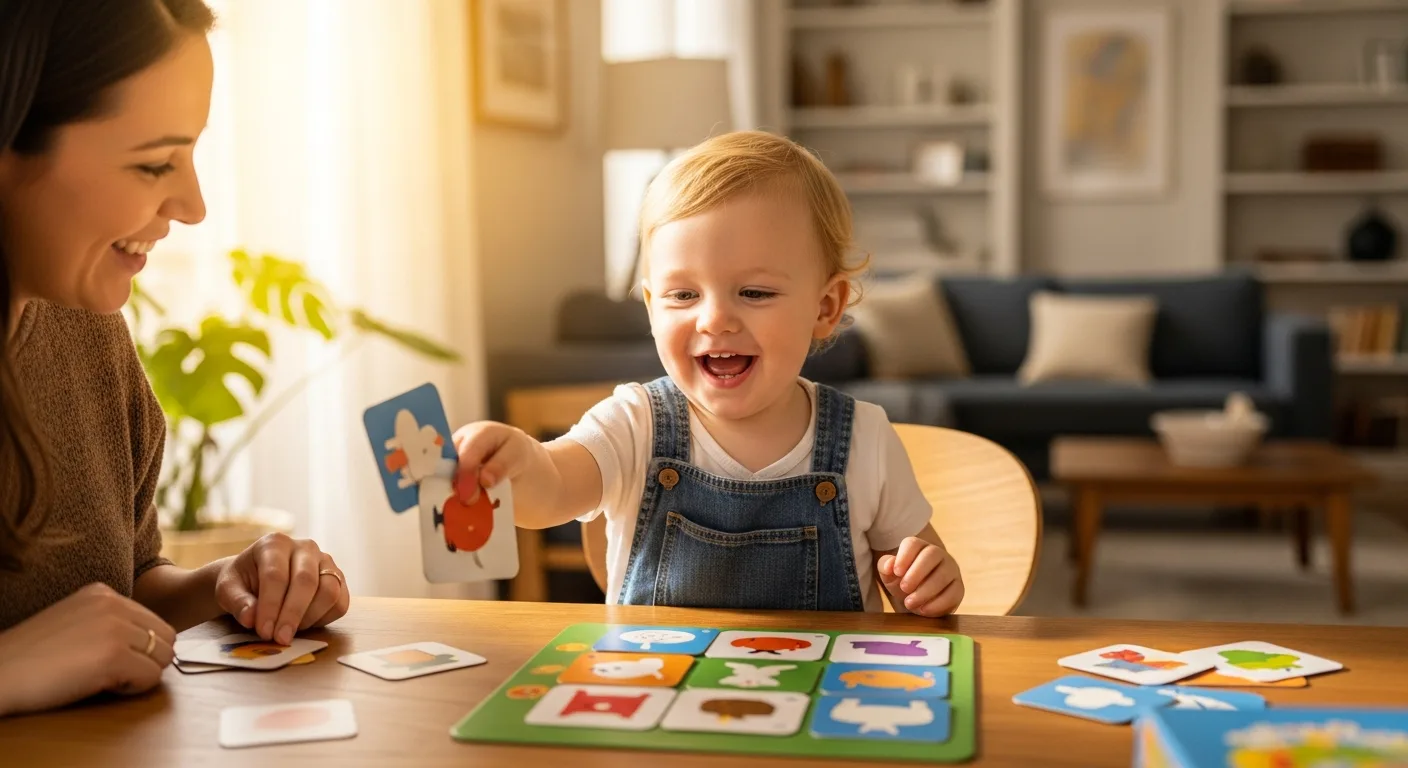
8. Classic pairs card game
2–3 yearsWhat you need: 6–8 matching pairs (12–16 cards)
How to play: Lay all cards face down in a grid. Take turns flipping two cards — if they match, keep them; if not, replace them face down. Play cooperatively, helping your toddler remember where cards are.
Why it helps: Classic pairs is the gold-standard visual memory game for this age group. It exercises working memory, visual discrimination, and the concept of spatial location memory all in one structured game.
9. Kim's game — what has been removed?
2–3 yearsWhat you need: A tray, 5 familiar objects, a cloth
How to play: Lay 5 objects on a tray, let your toddler study them for 30 seconds, cover with a cloth, secretly remove one, reveal the tray and ask what is missing.
Why it helps: Identifying an absence from a memorised set is a demanding memory task requiring both complete encoding and accurate comparison. It is one of the most developmentally rich memory games for this age.
10. I went to the shops
2–3 yearsWhat you need: Nothing
How to play: Take turns extending a growing list: 'I went to the shops and I bought an apple... an apple and a banana...' Use silly or imaginative items to make each addition memorable.
Why it helps: Verbal sequential memory is a direct precursor to early reading comprehension. Building a growing list together also introduces the memory strategy of using context to recall the next item.
11. Colour sequence copying
2–3 yearsWhat you need: Coloured blocks or pegs
How to play: Make a 3-colour sequence with blocks, let your toddler look for 10 seconds, cover it, and ask them to build the same sequence from memory. Start with 2 colours.
Why it helps: Short-term visual-spatial memory is directly exercised by sequence reproduction. This particular skill is a strong predictor of early mathematical and reading ability.
12. Sequence picture ordering
2–3 yearsWhat you need: 3-step story sequence cards
How to play: Show a 3-card picture sequence (e.g. planting a seed → watering it → flower growing). Mix up the cards and ask your toddler to put them back in the right order from memory.
Why it helps: Sequential memory — holding events in chronological order — underpins both narrative comprehension and early logical reasoning. Sequence cards are a natural bridge between visual and verbal memory.
13. Story retelling after reading
2.5–3 yearsWhat you need: A familiar picture book
How to play: After reading a favourite book, close it and ask your toddler to tell you what happened. Prompt gently: 'What happened first? And then what?' Celebrate every attempt warmly.
Why it helps: Narrative recall requires holding a sequence of causally related events in memory — one of the most cognitively complex memory tasks available at this age, and directly linked to later reading comprehension.
14. Daily routine picture ordering
2–3 yearsWhat you need: Simple pictures of your toddler's routine (can be drawn or photographed)
How to play: Create simple pictures representing the key events of the day — wake, breakfast, play, lunch, nap, snack, dinner, bath, bed. Mix them up and ask your toddler to arrange them in order.
Why it helps: Using personally familiar events maximises motivation and exercises episodic memory — memory for one's own experienced events — which develops rapidly at this age.
Ages 3–4Advanced Memory Games
15. Kim's game advanced
3–4 yearsWhat you need: A tray, 7–10 objects, a cloth
How to play: Expand Kim's game to 7–10 objects. For added challenge, try removing two objects at once, or ask your toddler to tell you everything they can remember about each object before the reveal.
Why it helps: Increasing the memory load systematically stretches working memory capacity. The added narration variant also introduces the memory strategy of verbal labelling — naming things to remember them better.
16. Multi-step instruction game
3–4 yearsWhat you need: Nothing (household items for tasks)
How to play: Give a 3-step instruction in a normal calm voice: 'Go to the kitchen, put your cup on the table, then come back and give me a high five.' Ask your toddler to carry it all out in order.
Why it helps: Multi-step instruction following is a direct real-world test of working memory capacity. It is also one of the strongest predictors of school readiness, making it a particularly valuable game to practise regularly.
17. Memory drawing
3–4 yearsWhat you need: Paper, crayons, a simple picture
How to play: Show a simple picture (a house, a sun, a flower, a car) for 15 seconds. Cover it. Ask your toddler to draw what they saw from memory. Compare the drawings and celebrate the attempts.
Why it helps: Visual recall drawing requires holding a spatial image in working memory long enough to reproduce it — a significantly harder task than copying, and one that exercises visual-spatial memory specifically.
18. Yesterday recall conversation
3–4 yearsWhat you need: Nothing
How to play: At a casual moment — breakfast, in the car — ask your toddler to try to remember something from yesterday: what they had for dinner, who they played with, what the funniest thing that happened was.
Why it helps: Episodic memory — memory for personal past experiences — develops rapidly between ages 3 and 5. Regular casual recall conversations strengthen these neural pathways more effectively than any formal game.
19. Full classic pairs (large set)
3–4 yearsWhat you need: 10–12 matching pairs (20–24 cards)
How to play: Play classic pairs with a full set of 20+ cards. Introduce light competition — whoever finds the most pairs wins — while keeping the tone playful and letting your toddler win about 60% of the time.
Why it helps: A larger card set requires toddlers to hold significantly more spatial locations in memory simultaneously, providing a genuine challenge to working memory capacity at this age.
20. Telephone message relay
3.5–4 yearsWhat you need: At least 3 people
How to play: Whisper a short silly message to one player, who whispers it to the next, and so on. Compare the original message to what arrives at the end. Laugh together at how it changes.
Why it helps: Serial verbal memory — holding a spoken phrase in mind long enough to pass it on accurately — exercises phonological working memory in a format that is naturally funny and socially engaging for older toddlers.
Tips for Playing Memory Games With Toddlers
How you play matters as much as what you play. These four principles make memory games for toddlers more effective and more enjoyable for everyone.
Keep sessions short
Always stop before your toddler wants to stop. A 5-minute session that ends with your toddler still enthusiastic is worth more developmentally — and for future engagement — than a 15-minute session that ends in frustration. Frequency across days and weeks matters far more than the length of any single session.
Make it fun, not educational
The moment a memory game starts feeling like a test, engagement drops and the developmental benefit with it. Keep the tone playful, celebrate effort enthusiastically, make mistakes funny rather than disappointing, and let the game's own structure do the developmental work without you narrating it.
Follow their lead
If your toddler wants to play the same game 10 times in a row, let them. Repetition is how memory is built. If they want to change the rules, change the rules. The goal is sustained, engaged play — the exact format is secondary to whether your toddler is genuinely enjoying themselves.
Celebrate effort, not results
A toddler who reaches for a card, thinks carefully, and gets it wrong has done the developmental work. Praise the trying: 'You really thought about that one!' rather than 'That's wrong, it's over here.' The cognitive effort of attempting to remember is what builds memory — successful recall is just the reward.
For more on how to make learning activities genuinely engaging for toddlers, the fine motor activities for toddlers guide has a similar approach to keeping skill-building activities toddler-led and genuinely enjoyable.
Best Memory Game Toys and Resources for Toddlers
Most of the memory games in this guide require nothing beyond everyday household items. But if you are looking for dedicated memory game resources, here is what actually works well at each age:
Matching card sets
Look for cards with large, simple, clear images — animals, food, and everyday objects work best for toddlers. Avoid cards with intricate illustrations where the differences between cards are too subtle to spot quickly. Orchard Toys and Ravensburger both make good toddler-appropriate sets.
Object memory games (Kim's game kits)
A simple tray and a cloth is genuinely all you need for Kim's game. The objects can be anything from your kitchen drawers. However, purpose-made Kim's game sets with interesting, varied objects can be worth having for the variety they provide.
Screen-free alternatives
The best digital-free memory resources are picture books read aloud (for story retelling), homemade photo cards (photograph your toddler's belongings, print and cut), and simple nature collections (leaves, stones, shells) for Kim's game.
If you are looking for more activity ideas to go alongside memory play, the Toddler Activity Generator gives you instant personalised activity ideas based on your toddler's age — great for filling the time between memory game sessions.
Need activity ideas in seconds?
Try the Toddler Activity Generator — instantly get indoor and outdoor activity ideas tailored to your toddler's age.
Try the Toddler Activity GeneratorFrequently Asked Questions
What are good memory games for 2 year olds?+
The best memory games for 2 year olds are simple, visual, and short. Classic pairs matching with just 4–6 pairs (8–12 cards) is perfect — the picture-finding task is clear and the success rate is high enough to keep motivation up. The 'which cup is hiding the toy?' game (3 cups, one toy, slow shuffle) is another excellent 2-year-old memory game because the hidden-object concept is deeply engaging and requires no reading. Object disappearance games — hiding a familiar toy under a blanket and asking where it went after a short delay — also work well at this age. Keep all sessions to 5–10 minutes maximum.
How do you play memory with a toddler?+
To play classic memory (pairs) with a toddler, start with just 4 matching pairs (8 cards total) laid face down in a simple grid. Take turns flipping two cards at a time — if they match, keep them; if not, turn them back over. For toddlers under 2, play cooperatively rather than competitively, helping them find matches. For toddlers aged 2–3, gently remember where unmatched cards are to model the memory strategy. For ages 3+, you can introduce light competition, but let them win frequently to maintain motivation. The key is starting very small and only expanding the card count once your toddler is reliably succeeding.
Do memory games help toddler development?+
Yes — substantially. Memory games directly exercise working memory (the ability to hold and use information in mind briefly), which is one of the strongest predictors of later academic achievement. Visual memory games improve concentration and attention. Verbal memory games like 'I went to the shops' build phonological memory that underpins early reading. Tactile memory games develop sensory processing alongside memory pathways. Regular memory play also introduces toddlers to the concept of memory strategies — the idea that you can deliberately try to remember things — which is foundational for self-directed learning.
What are the best memory games for 3 year olds?+
Three year olds can handle more complex memory games than younger toddlers. The best options at this age include: classic pairs with 8–10 pairs (16–20 cards); Kim's game with 5–7 objects on a tray (cover with a cloth, remove one, ask what's missing); 'I went to the shops' memory chain (building a growing list of items together); multi-step instructions (give a 3-step instruction and ask them to carry it out in order); and story retelling after a picture book. Three year olds can also begin simple memory drawing — show a picture for 15 seconds, cover it, and ask them to draw what they saw.
How long should toddlers play memory games?+
Toddlers aged 12–18 months: 3–5 minutes maximum per memory game session. Toddlers aged 18 months–2 years: 5–8 minutes. Toddlers aged 2–3 years: 8–12 minutes. Toddlers aged 3–4 years: up to 15–20 minutes for games they enjoy. The most important rule is to stop before your toddler wants to stop — ending on success and enthusiasm builds a positive association with memory games that makes them want to return. Frequency matters more than duration: short daily or every-other-day sessions are significantly more effective for memory development than longer weekly ones.
Final Thoughts
Memory games for toddlers are one of those parenting activities where the investment is genuinely small and the return is genuinely large. Ten minutes of Kim's game before bed, a round of pairs after lunch, a quick 'I went to the shops' in the car — none of it feels like work, but cumulatively it is doing something real and lasting for your toddler's developing brain.
Start with the simplest game your toddler can succeed at, play it regularly, and move up in complexity when it starts to feel easy. The goal is never perfect recall — it is the consistent, joyful habit of exercising memory together. That habit, built now, pays dividends for years.