
Fun Indoor Activities for Toddlers
Toddlers are bundles of energy, curiosity, and imagination — which is wonderful, right up until the moment it starts raining, the temperature outside spikes, or you simply cannot face another trip to the park. When staying home is the only option, having a reliable bank of indoor activities for toddlers to draw from makes the difference between a day that flows and a day that drags.
The good news is that the best toddler activities at home do not require special equipment, elaborate setups, or a lot of your time. Most of the activities in this guide take minutes to prepare and can keep a toddler happily occupied for far longer than you might expect. Whether you are looking for rainy day toddler activities, ways to reduce screen time, or just fresh ideas to break the daily routine, you will find something here.
Why Indoor Activities Are Important for Toddlers
Fun indoor toddler activities are not just a way to fill time — they actively support the developmental work toddlers are doing every single day. When toddlers play, they are learning, and the right indoor activities make that learning rich and multi-dimensional.
Supports early learning
Activities like sorting, puzzles, and stacking build foundational maths and science concepts long before formal education begins. Even the most playful activities are learning activities in disguise.
Improves motor skills
Both fine motor skills (drawing, threading, playdough) and gross motor skills (obstacle courses, dance parties, indoor bowling) develop rapidly during the toddler years and need regular, varied practice.
Encourages creativity
Open-ended activities — art, building, pretend play — give toddlers space to make choices, solve problems, and express themselves in ways that more structured activities do not.
Helps reduce screen time
Having a rotation of engaging activities ready to offer makes it much easier to redirect toddlers away from screens. Engaged toddlers rarely ask for a device when they are deeply absorbed in play.
25 Fun Indoor Activities for Toddlers
Every easy indoor activity for toddlers below is designed to be simple to set up, genuinely engaging, and developmentally meaningful. Most use things you already have at home, and all can be adapted to your toddler's current age and interests.
1. Pillow Obstacle Course
Arrange sofa cushions and pillows on the floor to create a soft obstacle course your toddler can crawl over, jump between, and navigate around. Change the layout every few minutes to keep the challenge fresh and the excitement going.
What they learn: Gross motor skills, spatial awareness, coordination, and problem-solving as they figure out how to get from one end to the other.Parent tip: Use masking tape on the floor to mark a simple path between pillows. Even toddlers who can barely walk will attempt this with enormous enthusiasm.
2. Building Block Tower Challenge
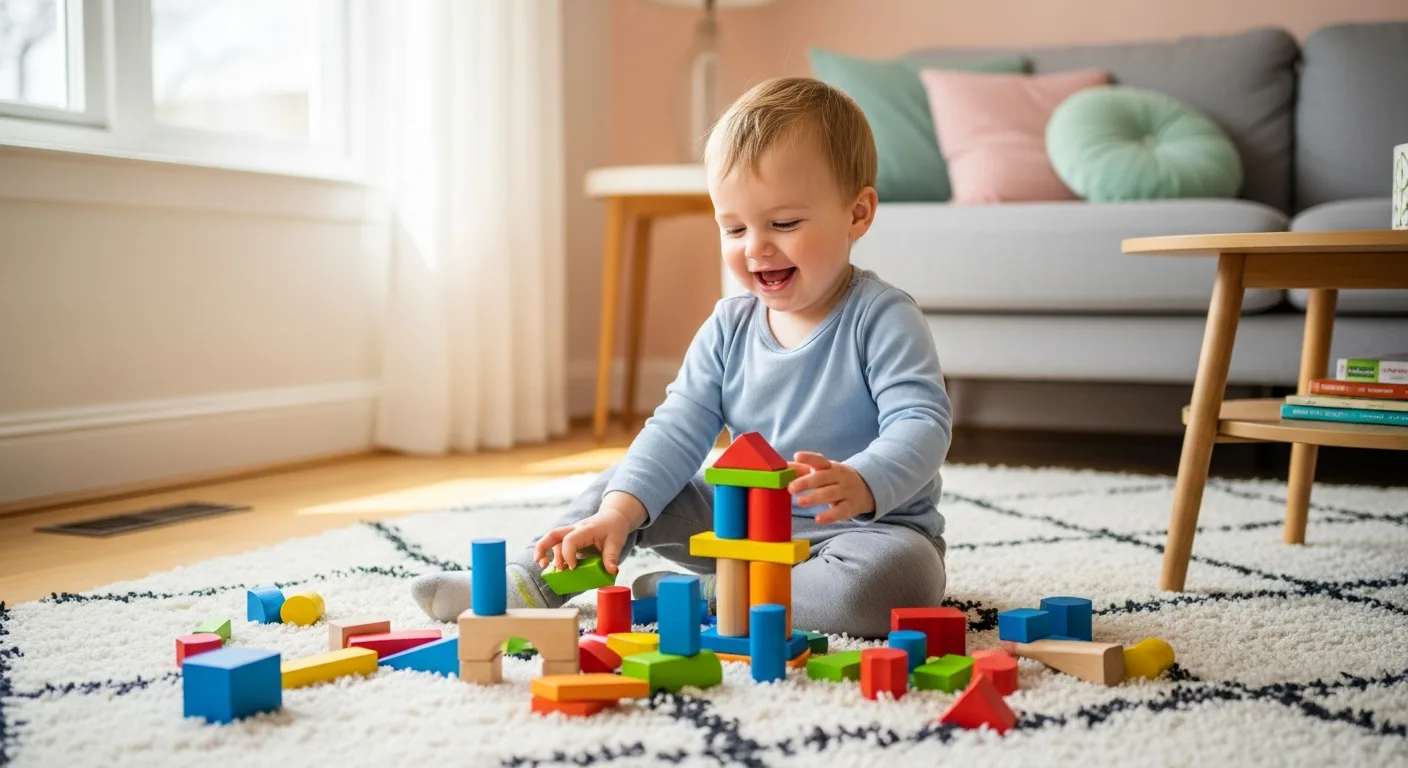
Set up a simple challenge: who can build the tallest tower before it falls? Duplo, wooden unit blocks, or even cardboard boxes all work brilliantly. The inevitable collapse is usually met with pure delight rather than frustration.
What they learn: Fine motor skills, hand-eye coordination, basic physics concepts, and early maths understanding through counting blocks.Parent tip: Start by building alongside your toddler so they understand the challenge, then step back and let them experiment independently. Resist the urge to fix their technique.
3. Indoor Scavenger Hunt
Hide five to ten familiar objects around a single room and give your toddler a simple picture list to find them. Even very young toddlers can manage a scavenger hunt when the items are visible and the search area is small.
What they learn: Observation skills, vocabulary, early literacy through picture matching, and persistence.Parent tip: Draw or print simple pictures of each item rather than writing words. Place objects in obvious spots for younger toddlers and slightly harder spots as they get more experienced.
4. Sticker Play
Give your toddler a sheet of colourful stickers and a large piece of paper, an old cardboard box, or a designated section of the window and let them stick freely. Few activities keep toddlers occupied for longer with so little setup.
What they learn: Fine motor skills and pincer grip through peeling stickers, colour recognition, and early creativity.Parent tip: Large dot stickers are easier for small fingers to peel than small or fiddly shapes. If the sticker budget is tight, address labels work just as well and come in huge quantities.
5. Colouring and Drawing
Set up a drawing station with chunky crayons, felt-tip pens, or watercolour paints and a generous supply of paper. Avoid colouring books initially — blank paper encourages more creative, open-ended mark-making.
What they learn: Fine motor control, colour recognition, self-expression, and early mark-making skills that lay the foundation for writing.Parent tip: Tape the paper to the table with masking tape so it does not slide around. This small change makes the experience much less frustrating for toddlers who are still developing hand steadiness.
6. Dance Party
Clear a small space, put on a favourite playlist, and have a full living room dance party. Toddlers love to move, copy adult dance moves, spin until they fall over, and jump to the beat — or completely ignore the beat, which is equally valid.
What they learn: Gross motor skills, rhythm and music appreciation, body awareness, and social connection when dancing with a caregiver.Parent tip: Mix familiar songs with one or two new ones each session. Freeze dance — stopping still when the music pauses — is a brilliant extension that toddlers find hilarious.
7. Reading Corner
Create a cosy reading nook with a blanket, a few cushions, and a basket of books. Let your toddler choose what to read and at what pace, even if that means spending ten minutes examining one page or asking to re-read the same book five times.
What they learn: Early literacy, language development, listening skills, and a love of books that pays dividends for years.Parent tip: Let toddlers hold the book and turn the pages themselves. The physical interaction with books is part of building reading readiness, not a distraction from it.
8. Sorting Toys by Colour
Set out bowls or trays in different colours and a mixed pile of toys, blocks, or pompoms and ask your toddler to sort everything into the matching bowl. This is a genuinely absorbing activity that toddlers often return to repeatedly.
What they learn: Colour recognition, categorisation skills, early maths concepts, and concentration through a focused, purposeful task.Parent tip: Start with just two colours and add more as your toddler becomes confident. You can also sort by shape, size, or type once colour sorting is mastered.
9. Playdough Creations
Playdough — homemade or shop-bought — is one of the most enduring and developmentally rich toddler activities. Provide rollers, cookie cutters, and safe plastic tools alongside the dough and let imagination take over.
What they learn: Finger strength, fine motor control, creativity, and sensory processing through the texture and resistance of the dough.Parent tip: Homemade playdough lasts for weeks in an airtight container and costs almost nothing. A basic recipe is 1 cup flour, half cup salt, 1 tablespoon oil, and half cup boiling water mixed together with food colouring.
10. Cardboard Box Play
A large cardboard box is one of the most open-ended, imaginative toys you can give a toddler. It becomes a car, a den, a rocket, a shop, or simply a box to climb in and out of repeatedly — all of which are equally valid and equally engaging.
What they learn: Imaginative and creative thinking, physical coordination through climbing and crawling, and early symbolic play.Parent tip: Cut windows and a door with scissors before giving it to your toddler. A few crayons inside the box for decorating is all you need to extend the activity for much longer.
11. Balloon Volleyball
Blow up a balloon and bat it back and forth across a low string, a sofa arm, or simply through the air. Balloons move slowly enough for toddlers to track and hit, making this one of the most inclusive and frustration-free physical games available indoors.
What they learn: Hand-eye coordination, gross motor skills, basic game concepts like taking turns, and tracking moving objects visually.Parent tip: Tie a piece of string between two chairs at toddler height to create a simple net. Keep multiple inflated balloons ready as they inevitably drift under furniture and need replacing.
12. Toy Car Race
Line up toy cars at one end of a hallway or use a cardboard ramp to race them down. Toddlers love the cause and effect of pushing a car and watching it travel, and they will repeat this happily dozens of times.
What they learn: Basic physics concepts, cause and effect, fine motor control through pushing and launching, and imaginative play.Parent tip: Make a simple ramp from a piece of cardboard and a stack of books to elevate one end. Measure distances with a piece of string for an older toddler who is ready for a more structured challenge.
13. Stacking Cups Challenge
A set of nesting or stacking cups is one of the most versatile toddler toys available. Stack them up, knock them down, nest them inside each other, fill them with water in the bath, or use them to sort small objects.
What they learn: Fine motor skills, sequencing, early maths through size ordering, and problem-solving when figuring out how nesting cups fit together.Parent tip: Old plastic cups or containers from the kitchen work just as well as dedicated stacking cup toys. The activity is the same and the cost is zero.
14. Simple Puzzle Play
Chunky wooden knob puzzles or simple foam floor puzzles are ideal for toddlers. The satisfaction of placing the last piece correctly is a genuine confidence builder that motivates toddlers to attempt the puzzle again and again.
What they learn: Problem-solving, spatial reasoning, fine motor control, shape recognition, and persistence through a challenging but achievable task.Parent tip: For younger toddlers, start with three to five piece puzzles and only add more pieces when they complete the current one independently without frustration.
15. Pretend Cooking
Set up a small pretend kitchen area with a pot, a spoon, some dried pasta, and a colander and watch your toddler spend a genuinely surprising amount of time stirring, pouring, and presenting you with elaborate imaginary meals.
What they learn: Imaginative and symbolic play, early understanding of sequencing and real-world processes, language development through narrating their cooking.Parent tip: Rotate the pretend ingredients periodically — dried beans, large pasta shapes, pebbles from the garden, or scraps of fabric all make excellent additions to a pretend kitchen setup.
16. Indoor Bowling
Fill plastic bottles with a little rice or water to weight them slightly, stand them up at the end of a hallway, and roll a soft ball to knock them down. Toddlers find the crashing, knocking-over element absolutely irresistible.
What they learn: Gross motor skills, aim and direction, cause and effect, counting as pins fall, and the simple joy of controlled destruction.Parent tip: Start with the ball very close to the pins for very young toddlers and gradually increase the distance as their aim improves. Celebrate every knock-down regardless of how many pins fall.
17. Bubble Play
Blow bubbles for your toddler to chase, pop, and catch — or let them attempt to blow their own. Bubbles are one of those simple, inexpensive activities that reliably produce pure, uncomplicated joy in toddlers of almost every age and temperament.
What they learn: Tracking moving objects, gross motor coordination through reaching and jumping, and basic breath control when attempting to blow their own bubbles.Parent tip: Homemade bubble solution — washing-up liquid, water, and a dash of glycerine — makes much better, longer-lasting bubbles than most shop-bought versions. A wide, shallow tray works better than a bottle.
18. Musical Instruments Exploration
Gather toy instruments, or improvise with wooden spoons on pots, dried rice in a sealed container, or rubber bands stretched across a box. Let your toddler explore sounds freely rather than directing them toward any particular outcome.
What they learn: Sound discrimination, rhythm, creative expression, and cause and effect as they discover how different actions produce different sounds.Parent tip: Record a short video of your toddler's musical exploration to play back for them — toddlers are often fascinated by hearing themselves, and it extends the activity naturally.
19. Hide and Seek
Even a simplified version of hide and seek — where the hiding spots are obvious and the seeker makes plenty of noise to give hints — is enormously entertaining for toddlers. Object permanence, anticipation, and the thrill of being found are all irresistible.
What they learn: Object permanence, spatial awareness, emotional regulation through the anticipation and release of the game, and early social skills.Parent tip: Let your toddler 'find' you in increasingly obvious spots to build their confidence before making the game more challenging. Toddlers hiding behind their own hands and declaring they are invisible is a completely valid stage of development.
20. Sensory Bin Play
Fill a shallow tray or storage bin with dried rice, oats, sand, or water and add small toys, cups, and spoons for scooping, pouring, and burying. Sensory bins are one of the most reliably absorbing independent activities for toddlers.
What they learn: Sensory processing, fine motor skills through scooping and pouring, early science concepts like volume and filling, and independent concentration.Parent tip: Place the bin on a towel or a play mat to contain the inevitable spillage. The cleanup is much more manageable when you expect it rather than hoping to prevent it.
21. Stuffed Animal Tea Party
Set up a small tea party with stuffed animals or dolls as guests, child-safe cups, and pretend food or real snacks. Your toddler becomes the host, pours the tea, offers biscuits, and manages the entire social occasion with tremendous seriousness.
What they learn: Imaginative and social play, language development through narrating and role-playing, early social skills like hosting and sharing.Parent tip: Use real water and real (toddler-safe) snacks occasionally to make the tea party feel more authentic and special. The combination of imaginative play and real food is very engaging for toddlers.
22. Blanket Fort
Drape blankets and sheets over chairs, a table, or a sofa to create a cosy enclosed den your toddler can retreat into with books, soft toys, and a torch. The enclosed space feels magical and toddlers often spend long periods happily inside their fort.
What they learn: Imaginative play, a sense of personal space and ownership, and the satisfying experience of creating an environment of their own.Parent tip: Let your toddler contribute to building the fort — even handing you pegs or arranging cushions gives them ownership over the space. A small torch or string of battery lights transforms the experience completely.
23. Animal Movement Game
Call out animal names and move around the room together imitating how each animal moves — stomp like an elephant, hop like a frog, slither like a snake, gallop like a horse. Toddlers find this endlessly funny and it burns a surprising amount of energy.
What they learn: Gross motor skills, body awareness, vocabulary through learning animal names and movements, and listening and responding to instructions.Parent tip: Use picture cards or a picture book of animals as prompts if your toddler needs more support connecting the animal name to the movement. The sillier the adult's performance, the more engaged the toddler.
24. Simple Craft Time
Set up a simple craft activity appropriate to your toddler's age — gluing torn paper pieces onto card, making a collage from magazine scraps, or painting with sponges. The process is the point rather than the finished product at this age.
What they learn: Fine motor skills, creativity, colour awareness, and the concept of making something new from separate materials.Parent tip: A dot of glue stick applied by you with your toddler pressing the pieces is often more satisfying for young toddlers than trying to manage the glue themselves. As control improves, hand over the glue stick.
25. Building a Train Track
Wooden train tracks or toy rail sets are a classic for good reason — connecting the pieces, planning the route, and then running trains around the completed track engages toddlers for extended periods of concentrated, purposeful play.
What they learn: Spatial reasoning, problem-solving, fine motor skills through connecting track pieces, and imaginative play as they create destinations and stories for their train.Parent tip: Start with a very simple oval layout and let your toddler extend it piece by piece. Toddlers often find the track building more engaging than the actual train running, so let them lead.
Looking for toddler meal ideas too?
Try our Toddler Meal Generator to get quick breakfast, snack, and dinner ideas for your little one.
✨ Try the Toddler Meal GeneratorTips for Keeping Toddlers Engaged Indoors
Even the best toddler boredom busters lose their appeal when offered too frequently. A few simple habits make indoor play feel fresh and engaging day after day.
- 🔄
Rotate toys regularly
Store a portion of your toddler's toys away and swap them out every week or two. Toys that reappear after a break feel completely new and exciting again — it genuinely works and costs nothing.
- ⏱️
Keep individual activities short
Toddlers have short attention spans by design, not by deficiency. Offer five to ten minutes of one activity before transitioning to something different. Following your toddler's lead on when to move on is always more effective than pushing them to stay with something longer.
- 🎨
Lean into open-ended activities
Activities with no fixed outcome — playdough, art, building, pretend play — keep toddlers engaged longer than activities with a definitive end point. The exploration is the point.
- 🙌
Allow and encourage independent play
Not every activity needs your full participation. Setting up an activity, playing alongside briefly, and then gradually stepping back gives toddlers the chance to develop the ability to entertain themselves — a skill that pays enormous dividends as they grow.
Indoor Activities for Rainy Days
Rainy day toddler activities work best when you have a loose plan rather than improvising from scratch when a fractious toddler is already climbing the walls. Keeping a small box of rainy day supplies ready makes the whole process faster and calmer.
Rainy Day Box
Keep a box with a few special items — a new colouring book, a packet of stickers, a small sensory bin ingredient, or an activity kit — that only comes out on stuck-at-home days.
Quick Setup Activities
Blanket forts, balloon play, and dance parties all take under two minutes to set up and reliably redirect toddler energy when weather suddenly keeps you inside.
Kitchen Time
Toddlers helping with simple cooking or baking tasks — mixing, pouring, washing vegetables — is a wonderful rainy day activity that feels purposeful and special rather than like passing time.
After a busy morning of activities, a good snack break always helps reset energy. The healthy snacks for toddlers guide and the healthy finger foods for toddlers article both have quick, fuss-free ideas that work perfectly for a mid-morning or mid-afternoon break.
More Helpful Toddler Resources
Final Thoughts
Easy indoor activities for toddlers do not need to be Pinterest-perfect or involve elaborate craft supplies. A blanket fort, a pile of blocks, a bowl of dried pasta, and a box of stickers are genuinely enough to create a rich, developmentally meaningful play experience for a toddler.
The activities in this guide are intentionally simple — because simplicity is what actually works day after day, in real family life, with real levels of parental energy. The goal is not an Instagram-worthy activity table. The goal is a toddler who is engaged, learning, and happy, while you have a moment to breathe.
Keep a loose mental list of five or six activities your toddler currently loves, rotate them regularly, and add new ones from this list gradually as your toddler's skills and interests develop. Simple toddler games at home are some of the most powerful learning tools available — and they cost almost nothing. You are doing brilliantly.