
Outdoor Activities for Toddlers in Any Weather: 25 Ideas That Work
One of the most common things parents say about outdoor play is that the weather stopped them. It was too hot, too cold, too cloudy, or it had rained. But the truth is that outdoor activities for toddlers work in almost every weather condition — they just look a little different depending on what the sky is doing.
This guide covers exactly that: 25 brilliant toddler outdoor activities that work year-round, plus a practical breakdown of the best activities for sunny days, cloudy days, hot weather, and cool weather so you always have a plan whatever the forecast says. Getting outside regularly — even briefly, even in grey drizzle — is one of the most beneficial habits you can build into your toddler's daily routine.
If outdoor play is not possible on a particular day, the fun indoor activities for toddlers guide has 25 more ideas that work just as well when you are stuck inside. And for days at the park specifically, the park activities for toddlers post has a dedicated list of ideas that work specifically in that environment.
Why Outdoor Play Is Important for Toddlers
Fun outdoor activities for toddlers are not just a way to burn energy before nap time — though they do that brilliantly. Outdoor play actively supports physical, cognitive, and emotional development in ways that indoor environments simply cannot replicate. The combination of space, natural sensory input, varied terrain, and unstructured time makes the outdoors one of the most powerful learning environments available to young children.
Research consistently shows that toddlers who spend more time outdoors have better gross motor skills, more restful sleep, improved mood regulation, stronger immune systems, and higher levels of curiosity and attention. These are not small benefits — they are foundational to healthy development. The good news is that achieving them requires no specialist equipment, no planned curriculum, and no Instagram-worthy setups. A patch of ground and permission to explore is genuinely enough.
Supports physical development
Running, climbing, jumping, and carrying develop gross motor skills, muscle strength, and cardiovascular fitness in ways only fully achievable in the space and freedom of outdoor environments.
Improves coordination and balance
Uneven surfaces, hills, steps, and varied terrain challenge toddlers' balance and body awareness constantly, building physical competence far more effectively than flat indoor floors.
Encourages exploration and curiosity
The natural world is endlessly novel. Insects, weather, plants, mud, water, and animals all generate natural curiosity and build the habit of paying close attention to the world.
Helps toddlers sleep better
Toddlers who spend meaningful time outdoors — particularly in natural light and physical activity — consistently sleep better and longer. Their bodies are genuinely tired, and their nervous systems have been appropriately stimulated.
Outdoor Toddler Activities for Every Type of Weather
The biggest shift in building a consistent outdoor play habit is moving away from the idea that outdoor play requires good weather. It does not — it requires the right activity for the weather you have. Here is a practical breakdown of what works best in each condition, so you are never caught without a plan.
☀️Best Outdoor Activities for Toddlers on Sunny Days
Sunny days are the classic backdrop for outdoor toddler play — and for good reason. Natural light supports healthy vitamin D levels, warm temperatures make sensory play (sand, water, grass) more comfortable, and the brightness makes the world feel more vivid and engaging to a young child. On a sunny day, lean into activities that use the outdoor environment at its best.
- Bubble chasing and blowing: Sunlight makes bubbles iridescent and magical. Even a basic bubble wand becomes a captivating outdoor activity when the light hits it right.
- Shadow play on the pavement: Show your toddler their shadow and yours. Chase them, stomp on them, make them wave. It is completely free, endlessly novel, and usually hilarious.
- Chasing butterflies and insects: Warm sunny days bring out pollinators. A slow walk through any garden becomes a wildlife-spotting adventure with a little patience.
- Chalk drawing and hopscotch: Bright sunlight makes chalk colours vivid. Draw on dry pavement and let your toddler create enormous, sprawling artworks with no consequence.
Parent tip: On very sunny days, head out before 10am or after 4pm to avoid peak UV hours. Always apply sunscreen before going outside — even on hazy days — and reapply after 2 hours.
⛅Outdoor Toddler Activities for Cloudy Days
Cloudy days are genuinely underrated for toddler outdoor play. The light is softer (easier on young eyes), temperatures are more comfortable for sustained physical activity, and there is no UV pressure. Many toddlers are actually more comfortable playing outside on overcast days than in bright sunshine — and the activities below work brilliantly regardless of whether the sun appears.
- Nature scavenger hunts: Overcast light is ideal for looking closely at the ground — leaves, stones, seed pods, and textures are easier to see without sun glare. Print a simple picture list and head out.
- Running races and obstacle courses: Physical play is better in cooler, overcast conditions. Toddlers can run, jump, and move for longer before tiring in mild weather without direct sun.
- Building stick houses and dens: Collecting natural materials and constructing things on the ground is a wonderful cloudy-day activity. The focus is inward — on building and imagining — rather than on sensory weather experiences.
- Ball games and kicking practice: A ball and a patch of grass is all you need. Cloudy days mean comfortable conditions for sustained back-and-forth play without anyone overheating.
Parent tip: Keep a bag by the door with a spare layer, a waterproof jacket, and a small snack. Being able to head outside within 2 minutes removes the mental barrier that stops many families from using cloudy days for outdoor play.
🌡️Outdoor Activities for Toddlers in Hot Weather
Hot weather does not mean staying inside all day — it means shifting what you do and when you do it. The best hot weather outdoor activities for toddlers are water-based (naturally cooling), happen in the early morning or late afternoon (avoiding peak heat between 11am and 3pm), and involve shade as much as direct sun. With the right approach, hot days can be some of the most memorable of the year.
- Sprinkler running and paddling pools: The combination of gross motor play and cooling water is perfect for hot days. Run the sprinkler on the lawn and let your toddler run through it repeatedly — this will occupy most toddlers for far longer than you expect.
- Water pouring and sensory play: A plastic tray, a bowl of water, and a selection of cups and spoons gives toddlers a deeply absorbing activity that also keeps them cool. Set it up in a shaded spot for best results.
- Painting the fence with water: Fill a bucket with plain water, hand your toddler a large paintbrush, and let them paint the fence, the path, the wall — anything. The painted patches dry in minutes and they can repaint repeatedly. Zero mess, maximum engagement.
- Early morning nature walks: Get outside by 8–9am when temperatures are still comfortable, the world is quieter, and birds and animals are more active. A morning nature walk in summer is one of the richest sensory experiences available to a toddler.
Parent tip: Offer water every 15–20 minutes during outdoor play in hot weather — toddlers do not reliably communicate thirst before they are already dehydrated. Keep sessions shorter and always have a shaded retreat ready.
🍂Outdoor Toddler Activities for Cool and Cold Weather
Cool and cold weather is not bad weather for toddler outdoor play — it is just weather that requires the right clothes. Layers, waterproofs, and a pair of wellies are genuinely all that stands between a miserable outdoor experience and a wonderful one. Many of the best toddler outdoor activities are actually at their most magical in autumn and winter: leaf collecting, puddle jumping, watching breath steam in cold air, and running until everyone is warm.
- Leaf collecting and sorting: Autumn produces an abundance of free, endlessly interesting natural materials for toddlers. Collect leaves of different sizes, shapes, and colours, then sort, arrange, and press them at home.
- Puddle jumping in wellies: Cold, wet days after rain are specifically designed for toddlers with good waterproof boots. The colder the puddle, the more satisfying the splash — layer up, head out, and embrace the mess.
- Running races to warm up: Cold air is a natural motivator for physical activity. Challenge your toddler to run to the tree and back, jump on the spot until you both feel warm, and turn 'getting warm' into a game rather than a problem.
- Bird watching and feeding: Winter brings birds to gardens and parks in search of food. Hang a simple bird feeder or scatter some seed, then watch together. Even very young toddlers become fascinated by birds when there are regular visitors to observe.
Parent tip: The dressing rule for cold weather outdoor play: your toddler will warm up quickly once they start moving, so start with one more layer than feels necessary and remove one when they begin running. Wet feet are the fastest route to an unhappy outdoor session — waterproof boots are non-negotiable.
25 Outdoor Activities for Toddlers
Every outdoor toddler game and activity below is chosen for simplicity, developmental value, and the very high likelihood that an actual toddler will enjoy it. No specialist equipment, no complex setup — just ideas that work in real outdoor spaces with real toddlers. For nature-focused activities specifically, the nature activities for toddlers guide goes even deeper on outdoor nature play ideas.
1. Bubble Chasing
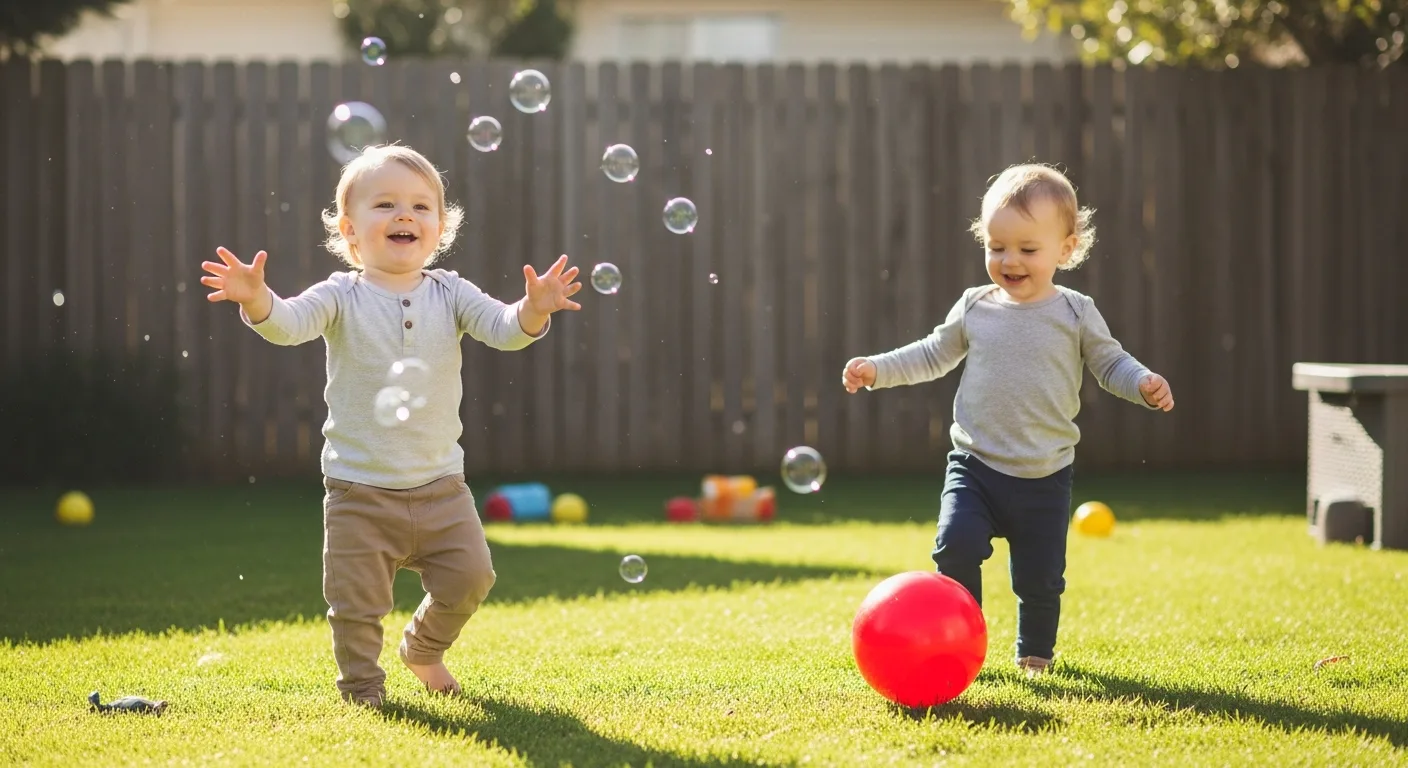
Blow a stream of bubbles and let your toddler run, jump, and reach to pop every one before it hits the ground. The combination of moving targets, sunlight catching the colours, and the satisfying pop makes this an activity toddlers will ask for over and over.
What they learn: Gross motor coordination, tracking moving objects visually, and the pure joy of physical play outdoors.Parent tip: Stand with the wind at your back so bubbles drift toward your toddler rather than away. A bubble machine frees your hands if you want to play alongside rather than just blow.
2. Nature Scavenger Hunt
Create a simple picture list of things to find outside — a leaf, a rock, something yellow, something bumpy, a stick, a flower — and head to the garden or park to find them all. Even very young toddlers can manage a three to five item picture-based hunt.
What they learn: Observation skills, vocabulary, early classification, and the habit of noticing and engaging with the natural world.Parent tip: Draw or print simple pictures of each item rather than writing words. Bring a small bag or basket for collecting so findings feel like genuine treasures.
3. Chalk Drawing on the Pavement
Chunky pavement chalk and a stretch of path or driveway gives toddlers an enormous canvas for drawing, mark-making, and creative expression — with easy cleanup built in courtesy of rain or a garden hose.
What they learn: Fine and gross motor skills, colour recognition, creativity, and early mark-making that supports pre-writing development.Parent tip: Draw outlines of your toddler's hands and feet for them to trace or colour in — most toddlers find this utterly fascinating and will return to it repeatedly.
4. Toddler Obstacle Course
Set up a simple outdoor course using garden furniture, hula hoops, chalk lines, low stepping stones, and anything else to hand. Ask your toddler to jump over the line, crawl through the hoop, run to the tree, and hop back.
What they learn: Gross motor skills, coordination, balance, listening and following instructions, and physical confidence.Parent tip: Keep obstacles very low and very safe for toddlers — the challenge should come from the sequence of movements, not the height or difficulty of individual elements.
5. Kicking a Ball
Kicking a large soft ball back and forth across a garden or park is one of the simplest and most developmental outdoor activities available. It looks like pure play — and it is, but it is also building a remarkable number of physical skills simultaneously.
What they learn: Gross motor coordination, balance while shifting weight, spatial awareness, and early turn-taking when kicking back and forth with a caregiver.Parent tip: Use the largest, softest ball you have for young toddlers — a large lightweight ball is much easier to aim at and much less frustrating than a small or heavy one.
6. Collecting Leaves and Flowers
Take a slow walk with a bag or basket and let your toddler collect fallen leaves, interesting stones, seed pods, and any flowers that are safe to pick. The walk itself becomes secondary to the discovery, which is exactly as it should be.
What they learn: Observation and attention to detail, vocabulary through naming finds, early science concepts about seasons and nature, and the pleasure of a slow, purposeful outdoor walk.Parent tip: Bring the collection home and press leaves in a heavy book, or arrange finds in a tray for a toddler-made nature display. The collection extends the activity well beyond the walk itself.
7. Water Play with Cups and Buckets
Fill a washing up bowl or shallow tray with water, hand over a selection of cups, spoons, sieves, and small containers, and watch your toddler spend a genuinely surprising amount of time pouring, filling, emptying, and starting again.
What they learn: Early science concepts about volume, pouring, and water properties, plus fine motor skills and the deeply satisfying sensory experience of water play.Parent tip: Add a few drops of food colouring or a squirt of washing up liquid for a variation. Place a towel or tray under the setup to reduce lawn flooding, and dress for mess — water play is always messier than expected.
8. Sandbox Play
A sandpit filled with dry or damp sand plus a few cups, spoons, small vehicles, and moulds is one of the most absorbing outdoor setups for toddlers. Sand offers endlessly satisfying sensory and physical feedback with every scoop, pat, and pour.
What they learn: Fine motor skills through digging and pouring, sensory processing, imaginative play through building and creating, and early science through exploring how wet and dry sand behave differently.Parent tip: Cover the sandpit when not in use to keep cats out and maintain clean, safe sand. Damp sand holds shapes better for building and is often more satisfying for younger toddlers than dry.
9. Running Races
Mark a start line and a finish line with chalk or two sticks and race your toddler from one end to the other — at whatever speed means your toddler wins most of the time. The format barely matters; the running, the anticipation, and the finish line delight are the entire point.
What they learn: Gross motor skills, speed and coordination, the concept of a start and finish, and the exhilarating physical experience of running hard outside.Parent tip: Let your toddler win frequently and celebrate their wins with genuine enthusiasm. This is not about athletic training — it is about building confidence and a love of moving their body.
10. Jumping in Puddles
If it has rained, put on waterproof boots and head outside specifically to jump in every puddle you can find. This is one of those simple, brilliant activities that costs nothing, requires no planning, and produces levels of joy entirely disproportionate to the effort involved.
What they learn: Gross motor skills and coordination through jumping, cause and effect as splashes respond to impact, and an early relationship with weather and the outdoors as something enjoyable rather than to avoid.Parent tip: Dress for the weather and embrace getting wet. The cleanup is easy — boots off at the door and straight into a warm bath. The memory lasts considerably longer than the mess.
11. Riding a Balance Bike
Balance bikes — pedal-free bikes that toddlers propel with their feet — are one of the best investments in outdoor physical development available. Most toddlers take to them remarkably quickly and will happily ride for much longer than they would walk the same route.
What they learn: Balance and coordination, spatial awareness, confidence on wheels, and physical fitness through sustained active movement.Parent tip: Start on a flat, smooth surface and resist the urge to hold or steady unless asked. Most toddlers figure out the balance independently much faster when given the space to wobble and correct themselves.
12. Feeding Ducks at the Park
A trip to a local pond or park to watch and interact with ducks is a classic toddler outing for very good reason. The combination of animals, water, and the cause-and-effect of throwing food makes it endlessly engaging for toddlers of almost any age.
What they learn: Empathy and gentle interaction with animals, vocabulary through naming birds and their behaviours, and the pleasure of a purposeful outing into nature.Parent tip: Bring oats, defrosted frozen peas, or lettuce rather than bread — these are much better for ducks and parks increasingly request this. Toddlers are just as engaged regardless of what is being thrown.
13. Toy Trucks in the Dirt
A patch of garden soil or a sandpit plus a collection of toy trucks, diggers, and construction vehicles is all that is needed for extended imaginative outdoor play. The combination of real earth and vehicles is powerfully engaging for toddlers who love construction themes.
What they learn: Imaginative and symbolic play, fine motor skills through digging and manoeuvring vehicles, and early science through interacting with soil and its properties.Parent tip: Create a dedicated digging patch in the garden if possible — a small area where digging is explicitly allowed. This reduces conflicts about where digging is and is not acceptable.
14. Blowing Bubbles
Letting your toddler attempt to blow their own bubbles — even when they mostly just dip the wand and wave it hopefully — is a fantastic outdoor activity that builds breath control and fine motor skills alongside the more obvious fun.
What they learn: Breath control, fine motor skills through handling the wand, and the concept of cause and effect as breath creates bubbles.Parent tip: Wide flat bubble trays and large wands make it much easier for toddlers to create bubbles themselves. Show them how to blow gently and slowly — the most common beginner mistake is blowing too hard.
15. Catch with a Soft Ball
Rolling or gently tossing a large soft ball and encouraging your toddler to catch, stop, or retrieve it builds physical skills through one of the oldest and simplest games in existence. Most toddlers find the back-and-forth rhythm genuinely satisfying.
What they learn: Hand-eye coordination, tracking a moving object, and early turn-taking — all packaged inside something that simply feels like playing.Parent tip: Start with rolling on the ground before attempting throwing and catching. For very young toddlers, sitting facing each other on the grass and rolling back and forth is plenty.
16. Building Stick Houses
Collect sticks on a walk or from the garden and build a miniature house, enclosure, or structure on the ground. This open-ended construction activity can be as simple or elaborate as your toddler's interest and patience allow.
What they learn: Creativity, problem-solving, early engineering and construction concepts, and a sense of connection with natural materials.Parent tip: Build a simple structure yourself first so your toddler understands what you are making, then invite them to add sticks and modify the design. Pretend animals living in the house extends the imaginative element significantly.
17. Outdoor Story Time
Spread a blanket under a tree, bring a bag of books, and read together outside. The change of environment makes familiar books feel fresh, and the sensory richness of the outdoors — wind, birds, light through leaves — makes outdoor reading a genuinely special experience.
What they learn: Early literacy, language development, the love of books, and positive associations with being outdoors — all at once.Parent tip: Choose outdoor-themed books when possible to connect the reading to the environment. Books about animals, weather, seasons, and nature work particularly well for outdoor story time.
18. Simple Gardening
Give your toddler a small patch of garden bed, a child-sized trowel, and some easy-to-grow seeds like sunflowers, nasturtiums, or beans, and help them plant and care for their own plants. The waiting and watching are as valuable as the planting itself.
What they learn: Responsibility and nurturing, early science through understanding how plants grow, patience, and a lifelong relationship with growing things.Parent tip: Fast-growing plants with big seeds are best for toddlers — sunflowers and beans are ideal because the seeds are easy to handle and results appear quickly enough to maintain interest.
19. Chasing Butterflies
Simply walking slowly through a garden or park looking for butterflies, bees, ladybirds, and other insects — and moving gently toward them — is a wonderful early nature activity that cultivates observation, patience, and delight in small living things.
What they learn: Observation and attention skills, patience, vocabulary through naming insects and creatures, and a gentle respectful attitude toward nature.Parent tip: Encourage watching rather than catching — even toddlers can understand the concept of looking with their eyes and not their hands with gentle, consistent guidance.
20. Outdoor Hide and Seek
A garden version of hide and seek — where hiding spots are obvious and the seeker calls out encouragingly — is a classic toddler outdoor game that never seems to lose its appeal. The anticipation of being found generates an emotional experience toddlers find thrilling.
What they learn: Spatial reasoning and an understanding of being hidden and found, emotional regulation through managing anticipation, and the pleasure of a simple shared game.Parent tip: Make your hiding spots progressively less obvious as your toddler's confidence grows. Toddlers hiding behind thin trees while entirely visible is a completely valid and wonderful developmental stage.
21. Jumping Over Lines
Draw lines, shapes, or patterns on the pavement with chalk and ask your toddler to jump over each one, jump into the shapes, or follow a chalked path with jumping, hopping, and leaping. The activity is endlessly adaptable based on what shapes you draw.
What they learn: Gross motor skills and coordination, shape recognition, following simple instructions, and the physical confidence that comes from managing their own body through space.Parent tip: Draw a hopscotch grid for an older toddler, or simply a wiggly line to jump over repeatedly for younger ones. Adding numbers or colours to shapes introduces early maths concepts naturally.
22. Walking Nature Trails
A slow, toddler-paced walk along a nature trail — with full permission to stop, crouch, poke, examine, and dawdle as much as needed — is one of the richest outdoor experiences you can offer a young child. Speed is entirely irrelevant; attention is everything.
What they learn: Stamina and physical endurance, observation and attention to the natural world, vocabulary through naming what they find, and a lifelong love of being in nature.Parent tip: Pack a simple snack — something from the healthy toddler snacks guide works perfectly — for a trail-side break. A mid-walk snack transforms a nature walk into a genuine adventure.
23. Toddler Picnic
Spreading a blanket on the garden lawn or at the park and eating lunch or a snack as a picnic gives an ordinary meal an extraordinary quality in the eyes of a toddler. The blanket, the basket, and the being-outside transform a routine into a memory.
What they learn: Independence through managing their own food and drink outdoors, social skills through the shared nature of a picnic, and positive associations between food, nature, and enjoyment.Parent tip: Let your toddler help pack the picnic basket and choose one item to bring. Ownership of the setup makes the event significantly more exciting than simply appearing at a blanket someone else prepared.
24. Sprinkler Play
Running through a garden sprinkler on a warm day is a classic toddler activity that provides outstanding gross motor exercise, sensory experience, and cooling fun simultaneously. Few outdoor activities generate as much pure physical joy as water in hot weather.
What they learn: Gross motor skills and whole-body coordination, sensory experience through water temperature and movement, and physical confidence through managing the surprise of getting wet.Parent tip: Run through alongside your toddler rather than just watching — your participation transforms the experience from something slightly alarming to something thrillingly fun. Dress in swimwear to make cleanup painless.
25. Rolling Balls Down Hills
Find a gentle grassy slope and roll balls of different sizes down it, watching how they travel, curve, and stop. Then climb back up and do it again — and again, and again, because cause-and-effect play is deeply satisfying for toddlers at any level of repetition.
What they learn: Early physics concepts about gravity, slope, and momentum, observation skills through noticing how different balls behave differently, and the physical exercise of repeatedly climbing the hill.Parent tip: Bring several different balls — a large soft ball, a smaller rubber ball, a tennis ball — and compare how they roll. Even toddlers notice and become curious about the differences.
Looking for toddler meal ideas too?
Try the Toddler Meal Generator to get quick breakfast, snack, and dinner ideas for your toddler — great for refuelling after an active outdoor session.
✨ Try the Toddler Meal GeneratorSafety Tips for Outdoor Toddler Play
Toddler outdoor play ideas work best when you have a few simple safety habits in place that become automatic rather than requiring active thought during play. None of these tips are complicated — they are just worth making habitual.
- 👁️
Supervise closely, always
Toddlers move fast and make decisions quickly — supervision is never something to reduce outdoors. Stay within arm's reach in unfamiliar environments and maintain clear sightlines even in familiar ones.
- 📍
Choose safe play areas
Check outdoor play spaces for hazards before your toddler arrives — sharp objects, uneven surfaces, water hazards, and unsafe equipment. A quick scan on arrival is a habit worth building.
- 💧
Stay hydrated
Toddlers do not reliably communicate thirst until they are already dehydrated. Offer water regularly during outdoor play, particularly on warm days or during energetic activities, without waiting to be asked.
- ☀️
Sun protection every time
Apply broad-spectrum SPF 30 or higher sunscreen before going outside — even on cloudy days — and reapply every two hours during extended outdoor sessions. A hat and light protective clothing add additional protection in strong sun.
Frequently Asked Questions
What outdoor activities can toddlers do on a rainy or cloudy day?+
Cloudy and rainy days are some of the best for outdoor play with toddlers. Jumping in puddles in waterproof boots is a classic for good reason — it is free, thrilling, and requires zero equipment. Other great options include nature scavenger hunts (overcast light is actually easier on young eyes), stick building, muddy digging in the garden, and chalking on the pavement before the rain arrives. The key is dressing correctly: waterproof boots, a raincoat, and the expectation of getting muddy transforms a grey day into an adventure.
How long should toddlers spend outside each day?+
Most child development guidelines suggest toddlers benefit from at least 3 hours of physical activity spread across the day, and a significant portion of that is best done outdoors. In practical terms, two outdoor sessions — a morning outing and a shorter afternoon one — typically covers this easily. On very hot or very cold days, shorter but still meaningful outdoor time (even 20–30 minutes in the right conditions) is better than staying in all day. There is no firm upper limit: toddlers who spend more time outdoors consistently show better sleep, mood, and physical development.
What outdoor activities are best for hot weather with toddlers?+
In hot weather, water-based activities are the most toddler-friendly outdoor option because they are both cooling and highly engaging. Running through a garden sprinkler, filling buckets and cups with water for pouring play, painting with water on fences or pavements, and playing in a shallow paddling pool are all excellent choices. Aim to go out in the morning (before 10am) or late afternoon (after 4pm) during peak summer heat, keep sessions shorter, offer water frequently, and apply SPF 30+ sunscreen before heading out.
Can toddlers play outside in cold weather?+
Yes — with the right clothing, cold weather outdoor play is fantastic for toddlers. The general rule is to dress in layers: a moisture-wicking base layer, an insulating mid-layer, and a waterproof outer layer, plus hat and gloves once temperatures drop below 10°C (50°F). Cold-weather activities that work brilliantly include puddle jumping, collecting fallen leaves, nature walks, bubble blowing (bubbles behave differently in cold air, which fascinates toddlers), and running races to warm up. Avoid outdoor play in extreme cold (below -10°C / 14°F), strong winds, or ice conditions that could cause slips.
What outdoor activities are good for toddlers with no garden?+
No garden is no obstacle to rich outdoor play. Local parks offer open space for running, ball games, climbing frames, and nature exploration. Pavements outside the front door are perfect for chalk drawing, scooter riding, and bubble play. Nature trails and woodland paths are among the richest environments for toddler-paced walks. Duck ponds, community gardens, and even a quiet car park can work for ball games and scooter practice. The most important thing is getting outside regularly — the venue matters far less than the habit.
More Helpful Toddler Resources
Final Thoughts
Outdoor activities for toddlers do not need good weather, a big garden, or elaborate planning. They need a willing adult, a toddler with boots on, and a few minutes outside. The sunny-day sprinkler session and the rainy-day puddle jump are equally valuable — what matters is the habit of getting out regularly, in whatever the day has to offer.
Toddlers who spend regular time in outdoor environments build physical confidence, develop a connection with the natural world, and accumulate experiences that support language, science, and social development — often without any of it looking like learning at all. It looks like jumping in puddles. It looks like collecting sticks. It looks like chasing a ball down a hill and then pushing it back up. All of it counts, whatever the weather.
On the days when outdoor play genuinely is not possible, the indoor activities guide has 25 more ideas to keep the energy and curiosity flowing. And on the days when everything feels hard, remember that even a short walk counts. You are doing a brilliant job.