
How to Teach Colors to Toddlers: 12 Simple and Fun Ways
Teaching colors is one of the earliest and most joyful learning milestones you will share with your toddler. Most children begin recognizing and naming colors between 18 months and 3 years, though the timeline varies widely. What matters more than pace is the approach: color learning happens most naturally through play, repetition, and connection to your toddler's everyday world.
In this guide, you will find out why color recognition matters, 12 practical ways to teach colors at home, and simple daily habits that make color learning stick — no flashcards or formal lessons required.
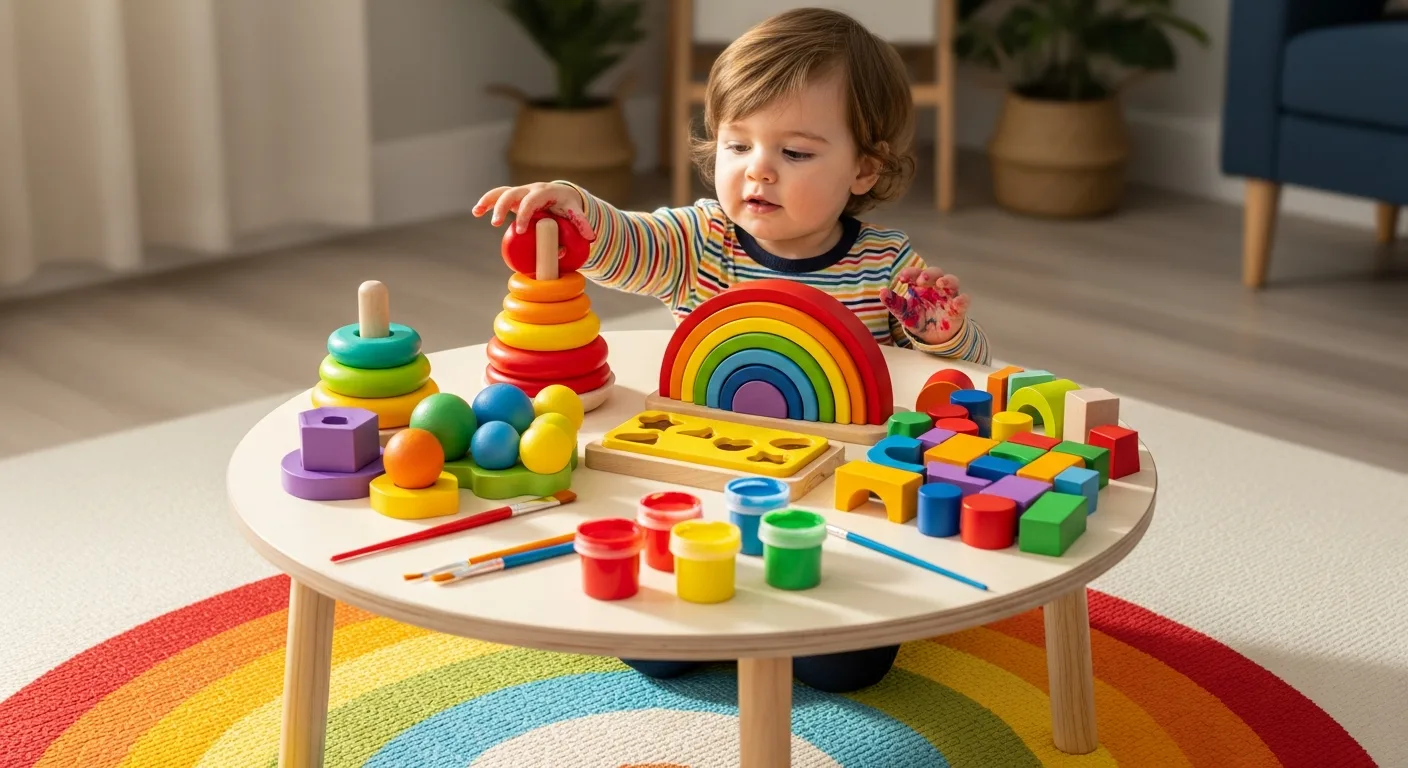
Why Learning Colors Matters for Toddlers
Color recognition is more than an academic skill. It is a building block for language development, observation, categorization, and early reading readiness. When toddlers learn to label and sort colors, they are developing the cognitive process of classification — grouping objects by a shared property — which is foundational to mathematical and scientific thinking.
Colors also give toddlers a richer vocabulary for describing the world. A child who knows "the red cup" or "the blue blanket" is communicating more precisely, which reduces frustration and builds confidence. And because color words appear constantly in picture books, signs, and conversation, mastering them opens up a wider range of engagement with the world around them.
For more on how play-based learning supports toddler development, see our guide to Learning Through Play at Home.
When Do Toddlers Learn Colors?
Most toddlers start to understand color concepts around 18 months and can correctly name most basic colors by age 3 to 3.5. However, correctly naming a color is harder than recognizing it — a toddler might point to the red object every time long before they can say "red." This gap between recognition and naming is entirely typical and not a cause for concern.
If your toddler is consistently confusing or unable to name any colors by age 4, it is worth mentioning to your pediatrician to rule out color vision differences, but most delays are simply a matter of exposure and practice.
12 Ways to Teach Colors to Toddlers
Name colors constantly in conversation
The simplest and most powerful technique is narrating colors as you go through the day. 'Here is your yellow banana.' 'Let's put on your green socks.' 'Look at that red car.' Casual, consistent color narration builds vocabulary without any pressure to perform.
Sort objects into color groups
Gather a mix of toys, blocks, or household items and sort them into groups by color. You can use colored bowls or trays to make it visual. Say the color out loud as you sort each item. Invite your toddler to help: 'Can you find another red one?' Sorting is highly engaging for toddlers because it satisfies their strong organizational instinct.
Play 'I Spy' with colors
I Spy is a classic game that works brilliantly for color learning. Say 'I spy something blue' and let your toddler search. Swap roles so they practice both recognizing and naming. This game works well in any room, in the car, at the supermarket, or at the park.
Use color-themed sensory bins
Fill a bin or tray with items all in one color — red objects one week, blue the next. Include small toys, fabric scraps, nature items, and safe household things. As your toddler explores, narrate the color. Sensory play engages multiple senses simultaneously, which strengthens memory formation.
Do color mixing with paint or food colouring
Mixing two primary colors to make a new one is genuinely magical to a toddler. Combine red and blue paint to get purple, yellow and blue to get green. Name the starting colors and the result. This is one activity that tends to produce high engagement and excellent color retention.
Read color-focused picture books
Books like 'Brown Bear, Brown Bear, What Do You See?' and 'Planting a Rainbow' make colors the central theme. Point to colors as you read, ask your toddler to find specific colors on each page, and revisit favourite books repeatedly — repetition is how toddlers learn.
Dress in color-of-the-week outfits
Pick one color for the week and look for that color everywhere: in clothes, food, toys, and outdoors. When everything you notice together is that color, the word becomes deeply associated with the concept. This immersive approach works especially well for toddlers who are just beginning to name colors.
Play color matching games
Cut colored circles from card stock and find objects around the house to match. Or use colored dot stickers on paper and have your toddler find toys that match each dot. Matching builds visual discrimination and reinforces color names through hands-on repetition.
Use colored cups and plates at mealtimes
Mealtimes offer built-in repetition. Using a specific colored cup or plate and naming it consistently — 'Here is your blue cup' — means your toddler hears the color word at every meal. Add a simple game: 'Can you find the green grapes? Yes, those are green!'
Paint or color with crayons freely
Free art time gives toddlers a chance to engage with colors on their own terms. Name the colors as they choose them: 'You picked orange. Nice bright orange.' Let them explore without direction. The relaxed, playful context makes color names easier to absorb.
Play with colored playdough
Roll, squish, and build with playdough in different colors. Ask your toddler to 'squish the yellow one' or 'make a ball with the blue.' Playdough play keeps hands busy while the brain absorbs color words through repetition in a low-pressure setting.
Go on a color scavenger hunt
Head outside and search for objects of a specific color. In the garden, on the street, at the park. Use a printed color card or a simple list of colors to check off. Movement and discovery together make this one of the most memorable color-learning activities you can do.
Daily Habits That Make Color Learning Stick
The most effective color teaching is not a dedicated activity — it is a layer of language woven through your day. Narrate the colors of food at mealtimes. Name colors when you get dressed together. Ask about colors in picture books. Point out the colors of cars, leaves, and buildings on your walks.
Teaching one color at a time is generally more effective than introducing all colors at once, especially for younger toddlers. Spend a week or two really focusing on red before moving to blue. When your toddler seems confident with one color, introduce another.
And remember: toddlers often know more than they can say. Your child might understand exactly which object is red long before the word "red" comes out correctly. Trust the process and stay curious alongside them. For more structured learning ideas, our Simple Toddler Curriculum at Home guide has a full framework you can follow.
Looking for more toddler ideas?
Try our Toddler Activity Generator and Meal Generator for instant ideas tailored to your toddler's age.
Get the 30 Easy Toddler Recipes PDF
Download our printable recipe guide — 30 quick, toddler-approved meals your family will love.
Get the 30 Easy Toddler Recipes PDF →Final Thoughts
Teaching colors does not need to be structured or stressful. The best color education happens in the flow of daily life — through books, meals, play, and outdoor adventures. Keep it light, keep it playful, and let your toddler set the pace. With consistent, gentle exposure, color naming will come — and it is one of those milestones that feels genuinely delightful when it clicks. For related ideas, explore our Simple Toddler Routine Tips and our Learning Through Play at Home guide.