
Encouraging Language Development at Home
The toddler years are a period of extraordinary language growth. Between the ages of one and three, most children go from a handful of recognisable words to hundreds, from pointing and gesturing to full sentences, from simple requests to complex questions about the world around them. Toddler language development during this window is faster and more remarkable than at almost any other point in human life.
The most powerful environment for this development is not a classroom or a language programme — it is home. Everyday conversations, shared books, songs in the kitchen, and play on the living room floor are the raw materials from which toddler speech development is built. This guide gives you ten evidence-based strategies for encouraging language development at home, along with activities, milestones, and reassurance for every stage of the journey.
Why Language Development Is Important for Toddlers
Language is the foundation on which almost everything else in a child's development is built. Early language skills do not just help toddlers talk — they shape their ability to think, learn, connect, and navigate the world.
Supports communication
Language gives toddlers the tools to communicate their needs, thoughts, and observations — reducing the frustration that leads to tantrums and strengthening the connection between parent and child.
Builds social connections
The ability to communicate is the foundation of all social relationships. Toddlers who can express themselves clearly find it easier to connect with other children, adults, and the broader world around them.
Strengthens learning abilities
Language and cognitive development are deeply intertwined. The richer a toddler's vocabulary and language experience, the better equipped they are to learn, understand concepts, and succeed academically later in life.
Helps express needs and emotions
When toddlers have words for their feelings — hungry, tired, sad, scared, excited — they can express and regulate emotions more effectively. Language is one of the most powerful tools for emotional development.
Language Development Milestones for Toddlers
Every child develops at their own pace, and there is a wide range of what is considered typical. These toddler talking milestones are general guides, not rigid benchmarks. If your toddler is progressing slightly outside these windows, it is usually nothing to worry about — but always trust your instincts and speak to your GP or health visitor if you have concerns.
12 months
First words
Most toddlers say their first recognisable word around twelve months. Common first words include 'mama', 'dada', 'no', 'hi', and the name of a beloved pet or sibling. Any consistent sound used meaningfully counts.
18 months
10–20 words
By eighteen months, most toddlers have a vocabulary of around ten to twenty words and are beginning to understand many more than they can say. They can typically point to familiar objects and body parts when named.
2 years
Two-word phrases
Around their second birthday, most toddlers begin combining two words — 'more milk', 'daddy gone', 'big dog'. This is a significant milestone showing that your toddler understands that words can be combined to create meaning.
2–3 years
Simple sentences
Between two and three years, language typically accelerates rapidly. Vocabulary grows from around fifty words to several hundred, and toddlers begin constructing short sentences. They understand simple instructions and love asking 'what' and 'why' questions.
A note on understanding: Toddlers typically understand significantly more language than they can produce. A toddler may follow a two-step instruction before they can string two words together. Receptive language (understanding) usually runs ahead of expressive language (speaking) — and both matter.
10 Simple Ways to Encourage Language Development at Home
These language development activities for toddlers require no special equipment and no formal teaching. They are built into the everyday rhythm of family life — and that is exactly where the most powerful language learning happens.
Talk to your toddler throughout the day
Narrate your activities, describe what you're doing, and talk through everyday moments — cooking, dressing, shopping. 'I'm putting your red shoes on now. First this foot, then this one.' This constant language exposure is the single most powerful driver of vocabulary growth.
Example: 'Let's wash the strawberries. Look — they're red and bumpy. Can you feel how cold the water is?'
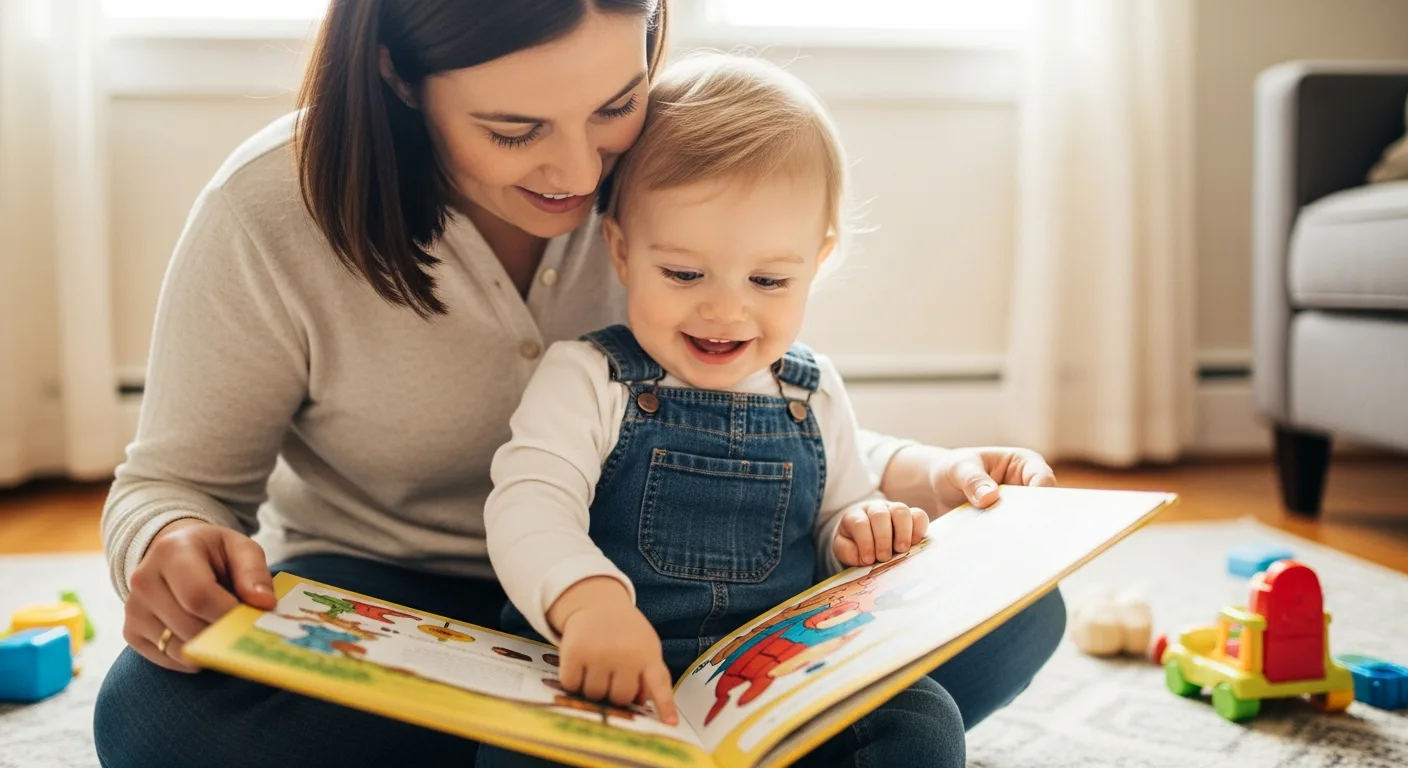
Read books together every day
Reading aloud exposes toddlers to vocabulary and sentence structures they would never hear in everyday conversation. It also builds comprehension, attention, and a crucial understanding of how stories work. Even short, simple picture books read daily make a measurable difference.
Tip: Point to pictures and name them. Ask 'What's that?' before you say the word. Give them a moment to try.
Sing songs and nursery rhymes
The rhythm and repetition of songs make new words and sounds easier to remember and reproduce. Nursery rhymes are particularly powerful — they draw attention to the sounds within words, which supports early literacy as well as language development.
Example: Wheels on the Bus, Twinkle Twinkle, and Incy Wincy Spider all combine rhythm, repetition, and actions that reinforce meaning.
Ask simple, open questions
Instead of yes/no questions, ask questions that invite a longer response: 'What did you do at the park?' or 'What colour is that?' Give your toddler time to think and respond. Their answer does not need to be perfect — the attempt is the learning.
Tip: If they do not respond, provide the answer yourself and move on naturally. Never pressurise a response.
Describe everyday activities
Describing what you and your toddler are doing as it happens — a running commentary on daily life — provides a continuous, contextualised stream of language input. The key is that the words are attached to real, visible things the toddler can see and feel.
Example: 'Now I'm chopping the banana. Chop, chop, chop. The banana is yellow inside. Shall we put it in the bowl?'
Encourage pretend play
Imaginative play is one of the richest contexts for language development. When toddlers play pretend — cooking, shopping, caring for toys — they use and rehearse language in purposeful, motivated ways. Join the play and model language naturally within the scenario.
Tip: Take a role in the play. 'I'd like to buy some apples please. How much do they cost?' gives your toddler language to borrow and use.
Expand what your toddler says
When your toddler says 'dog!', respond with an expanded version: 'Yes, a big fluffy dog! He's running fast!' This technique — called expansion or recasting — provides a natural model of fuller language without correcting or drilling.
Example: Toddler: 'Bird fly.' You: 'Yes! The bird is flying up into the sky. There it goes!'
Give time for responses
Toddlers need longer to process language and formulate responses than adults do. After asking a question, wait — a full five to ten seconds if needed — before filling the silence yourself. This 'wait time' is one of the most underused strategies for encouraging language.
Tip: Resist the urge to jump in. The pause feels long to you but is necessary processing time for your toddler.
Repeat and reinforce new words
When a toddler encounters a new word, they need to hear it many times in many contexts before it becomes part of their active vocabulary. Repetition is not boring — it is essential. Use new words naturally across different situations and in different sentences.
Example: If you introduce 'enormous' on Monday, find ways to use it again on Tuesday, Thursday, and the following week.
Limit screen time
Language is a social skill and it develops through interaction — two-way conversation, responsive communication, and real human connection. Screen time, even educational content, provides one-way language input without the interaction element that drives development. Active conversation with real people is irreplaceable.
Tip: When screens are used, watch together and talk about what you see: 'Oh look — the elephant is splashing water! Have you ever seen an elephant?'
Fun Language Activities for Toddlers
Beyond everyday conversation, these activities to help toddlers talk create dedicated, playful contexts for language practice. All of them are genuinely enjoyable — for your toddler, and for you.
Storytelling with picture books
Go beyond reading the text — use picture books as a springboard for conversation. Ask your toddler to tell you what they see on each page before you read the words. Create your own version of familiar stories together. This builds narrative language, imagination, and vocabulary simultaneously.
Naming objects during walks
A walk is a moving language lesson. Point to everything — trees, buses, shop signs, clouds, dogs, puddles — and name them. Ask your toddler to find things for you: 'Can you spot something red?' This combines vocabulary building with attention, observation, and following instructions.
Singing action songs
Songs like Head, Shoulders, Knees and Toes and The Hokey Cokey connect words to body movements, making vocabulary tangible and memorable. The physical action provides a concrete anchor for the word, making it far more likely to be retained and reproduced.
Matching pictures and words
Simple matching games — picture cards, photo albums, or even catalogues — give toddlers practice naming and categorising objects. Point to a picture and wait for your toddler to name it. Then confirm and expand: 'Yes! That's a helicopter. Helicopters fly really high.'
Simple role-playing games
Set up a pretend shop, a doctor's surgery, or a café and take turns being the customer and the provider. Role play gives toddlers a motivated context to use new vocabulary, practise conversational turn-taking, and rehearse social scripts they are learning from the world around them.
For more ideas on activities that naturally support language through play, the learning through play at home guide has 15 detailed activities covering all areas of development, and the fun indoor activities for toddlers guide and outdoor activities for toddlers guide both have plenty of language-rich ideas.
When Parents Should Seek Advice
Every child develops at their own pace, and there is significant natural variation in when individual children reach language milestones. Many toddlers who are slower to start talking go on to catch up entirely without any intervention. Comparison with other children or siblings is rarely helpful — and is almost always anxiety-inducing without being informative.
💛 Consider speaking to your health visitor or GP if your toddler:
- •Has no words at all by 16 months
- •Is not combining two words by 24 months
- •Loses language skills they previously had at any age
- •Does not respond to their name or simple instructions
- •You have any concerns about their hearing or communication
Early support for speech and language delays is genuinely effective — and accessing it early makes a significant difference. Your instincts as a parent are valuable. If something feels off, trust that feeling and seek a professional opinion. There is no threshold of concern you need to reach before asking.
Looking for toddler meal ideas too?
Try our Toddler Meal Generator to get quick breakfast, snack, and dinner ideas for your toddler.
✨ Try the Toddler Meal GeneratorMore Helpful Toddler Resources
Final Thoughts
Toddler language development does not require a programme, a curriculum, or any special parenting expertise. It requires what you already have: time, attention, and the willingness to talk to, play with, and read alongside your toddler in the ordinary moments of daily life.
Every conversation you have with your toddler — about the dog you saw on your walk, about what colour cup they want, about what happens next in the story — is an investment in their language, their thinking, and their future. None of it is wasted. All of it counts.
The most language-rich environment in the world is not a nursery or a programme. It is a home where a loving parent talks, listens, and responds. You are already building exactly that.