
Busy Toddler Activities for Working Parents: 15 Low-Supervision Ideas
If you work from home, handle calls and emails during the day, or simply need your toddler to engage independently for stretches of time, you know how challenging it can be to find activities that actually hold their attention without constant input from you. The key is not finding the cleverest activities — it is finding the ones that are appropriately set up, appropriately open-ended, and appropriately matched to your toddler's developmental stage.
In this guide, you will find out why independent play matters, 15 practical busy toddler activities that genuinely require low adult supervision, and tips for setting up an environment that helps your toddler sustain focus.
Why Independent Play Matters for Toddlers
Independent play is not just convenient for parents — it is genuinely beneficial for toddlers. When children play alone, they practise making decisions, managing frustration, and sustaining focus on their own terms. These are core executive function skills that underpin learning, self-regulation, and resilience.
Research suggests that toddlers who have regular opportunities for independent play develop stronger problem-solving abilities and higher frustration tolerance. It also builds their confidence: a toddler who regularly plays independently develops a growing sense of competence — "I can figure this out on my own."
Independent play capacity builds gradually. A 12-month-old might manage 5 minutes; a 3-year-old can often sustain 20–30 minutes when the environment and materials are right. For ideas that integrate well into a consistent routine, see our Simple Toddler Routine Tips.
15 Busy Toddler Activities for Working Parents
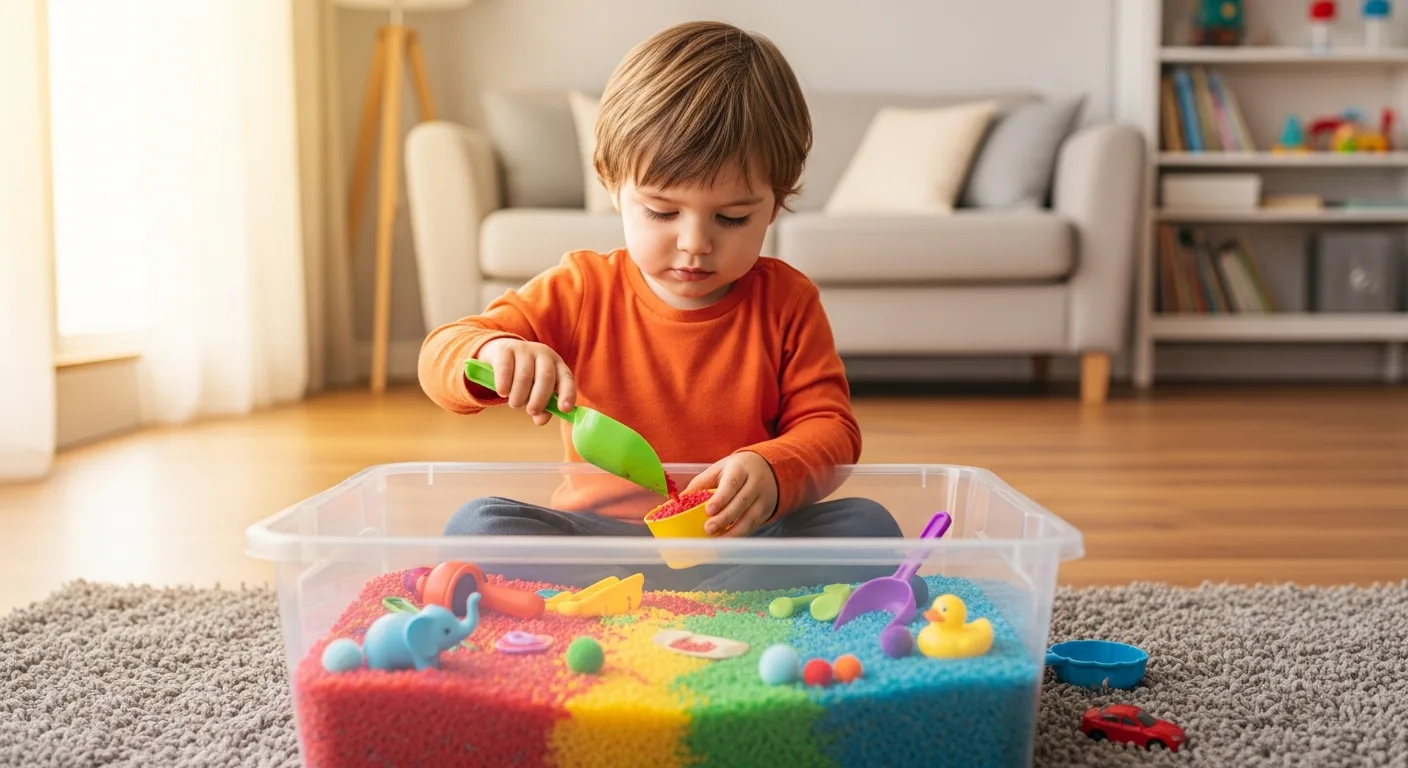
Sensory bin with dry goods
Fill a large container with dry rice, lentils, oats, or dried pasta. Add cups, spoons, small scoops, funnels, and small toys. Most toddlers will pour, fill, sift, and explore for 20–30 minutes. Set it on a large tray or old sheet for easy cleanup.
Sticker activity books
Simple sticker activity books where toddlers place stickers on matching outlines keep little hands busy for extended stretches. Choose themes your toddler loves — animals, vehicles, food. The satisfaction of peeling and placing is deeply engaging for toddlers.
Play dough with tools
Set out a tray of play dough with a rolling pin, cookie cutters, and plastic knives. Homemade or store-bought, play dough is one of the highest-engagement independent activities for toddlers because it is open-ended, tactile, and infinitely variable. Most toddlers can sustain 20+ minutes.
Water play at the kitchen sink
Set up a step stool at a low water level in the kitchen sink with cups, small containers, and waterproof toys. Water play is absorbing, sensory, and develops fine motor skills and early science concepts. Keep a towel nearby and change clothes beforehand for stress-free supervision.
Cardboard box construction
Save cereal boxes, toilet roll tubes, and small packaging and offer them with masking tape and crayons. Most toddlers will build towers, tunnels, vehicles, and houses for extended periods. The open-ended, building nature of this play sustains attention without requiring adult direction.
Simple posting and sorting toys
Shape sorters, posting boxes, stacking rings, and sorting trays engage toddlers in focused, satisfying cause-and-effect play. These are particularly effective as independent activities because they have a clear goal and produce an immediate, satisfying result.
Busy board or sensory board
A board with latches, zips, velcro, buttons, buckles, and light switches mounted safely is endlessly engaging for toddlers. You can make one with a piece of wood and hardware store fittings or purchase one. The focus on independent manipulation keeps hands busy for long stretches.
Drawing and mark-making station
A low table or high chair tray with chunky crayons, large paper, and dot-to-dot sheets gives toddlers an open-ended creative outlet. Rotate paper sizes and drawing tools regularly to maintain interest. Many toddlers will mark-make independently for 15–25 minutes when materials are fresh.
Magnatiles or magnetic blocks
Magnetic tiles are among the highest-engagement open-ended construction toys for toddlers. They are satisfying to click together, visually rewarding, and versatile enough to sustain play for long periods. Set them out on a flat surface and step back.
Colour and number matching games
Print or buy simple colour or number matching cards and a set of pegs, clips, or counters. Your toddler can match colours independently for extended stretches. This also builds early literacy and numeracy skills while you focus on work nearby.
Mirror and soft toy imaginative play
A low, unbreakable mirror placed on the floor with a collection of soft toys or small figurines invites imaginative, open-ended role play that toddlers can sustain entirely on their own. Many toddlers talk animatedly to their mirror reflection for surprisingly long stretches.
Floor puzzles
Large-piece floor puzzles (6–12 pieces for toddlers under 2.5; 12–24 pieces for older toddlers) provide a clear goal and a satisfying result. Rotate puzzles regularly to keep them feeling fresh and engaging. Puzzles also build problem-solving and spatial reasoning skills.
Bead threading activity
Large wooden or plastic beads with a thick shoelace or chunky threading cord develop fine motor skills and concentration. Supervise initial setup for safety with younger toddlers, then let them thread independently. This is an excellent quiet, focused activity that keeps hands busy.
Transferring activities with tongs or spoons
Set up two bowls and a collection of pom-poms, small blocks, or cotton balls. Provide tongs, spoons, or chopsticks and invite your toddler to transfer objects from one bowl to the other. This Montessori-style activity builds concentration, fine motor skills, and self-directed focus.
Audiobooks or story podcasts
Toddler-appropriate audiobooks and story podcasts allow children to engage with narrative and language independently. Pair with a colouring activity or simple manipulation toys. Many toddlers will listen and play simultaneously for 20+ minutes, giving parents extended focus time.
Setting Up for Independent Play Success
The activity itself is only half the equation. How you set it up matters enormously. A few key principles: rotate toys regularly so nothing feels stale; set up the activity before you need your toddler to engage with it; and briefly play alongside your toddler to get them started before stepping back.
A dedicated play space — even just a corner with a mat — signals to toddlers that this is where independent play happens. Limit visible toy options to 2–3 things at once; too much choice leads to overwhelm and shorter play spans, not longer ones.
For more ideas on structuring your toddler's day, see our Simple Toddler Routine Tips, and for activity inspiration any time, our Learning Through Play at Home guide.
Looking for more toddler ideas?
Try our Toddler Activity Generator and Meal Generator for instant ideas tailored to your toddler's age.
Get the 30 Easy Toddler Recipes PDF
Download our printable recipe guide — 30 quick, toddler-approved meals your family will love.
Get the 30 Easy Toddler Recipes PDF →Final Thoughts
Busy toddler activities are not about keeping your child occupied at any cost — they are about providing the right kind of environment and materials for genuinely independent, developmental play. When you get this right, everyone benefits: your toddler builds focus, creativity, and confidence, and you gain the protected time you need. For more ideas, explore our Healthy Toddler Meal Ideas and our full collection of toddler activities.