
15 Color Sorting Activities for Toddlers
Learning colours is one of the earliest and most important milestones in toddler development — and color sorting activities for toddlers are one of the most effective ways to build that understanding. Sorting by colour requires a toddler to observe, categorise, and match — three cognitive skills that underpin all later academic learning.
This list of 15 toddler color sorting games uses everyday household materials to make colour learning hands-on, playful, and genuinely engaging — without expensive educational toys or complex setup.
Why Color Sorting Helps Toddlers Learn
Sorting activities for toddlers build much more than colour knowledge. Every time a toddler classifies an object — this is red, not blue; this belongs here, not there — they are building the foundational cognitive skill of categorisation. This same skill underpins reading, mathematics, science, and logical thinking.
Pre-reading skills
Sorting and classifying are direct precursors to the kind of pattern recognition that early reading requires.
Early mathematics
Sorting by colour naturally leads to counting within each group — an early foundation for number sense and data handling.
Cognitive flexibility
Sorting the same objects by different attributes — first by colour, then by size — builds flexible thinking.
Language development
Colour sorting activities are rich opportunities for colour vocabulary, comparison language ('darker', 'lighter'), and descriptive language.
For more activities that specifically focus on colour recognition through art and play, our Color Learning Activities for Toddlers guide covers a complementary range of ideas.
15 Color Sorting Activities for Toddlers
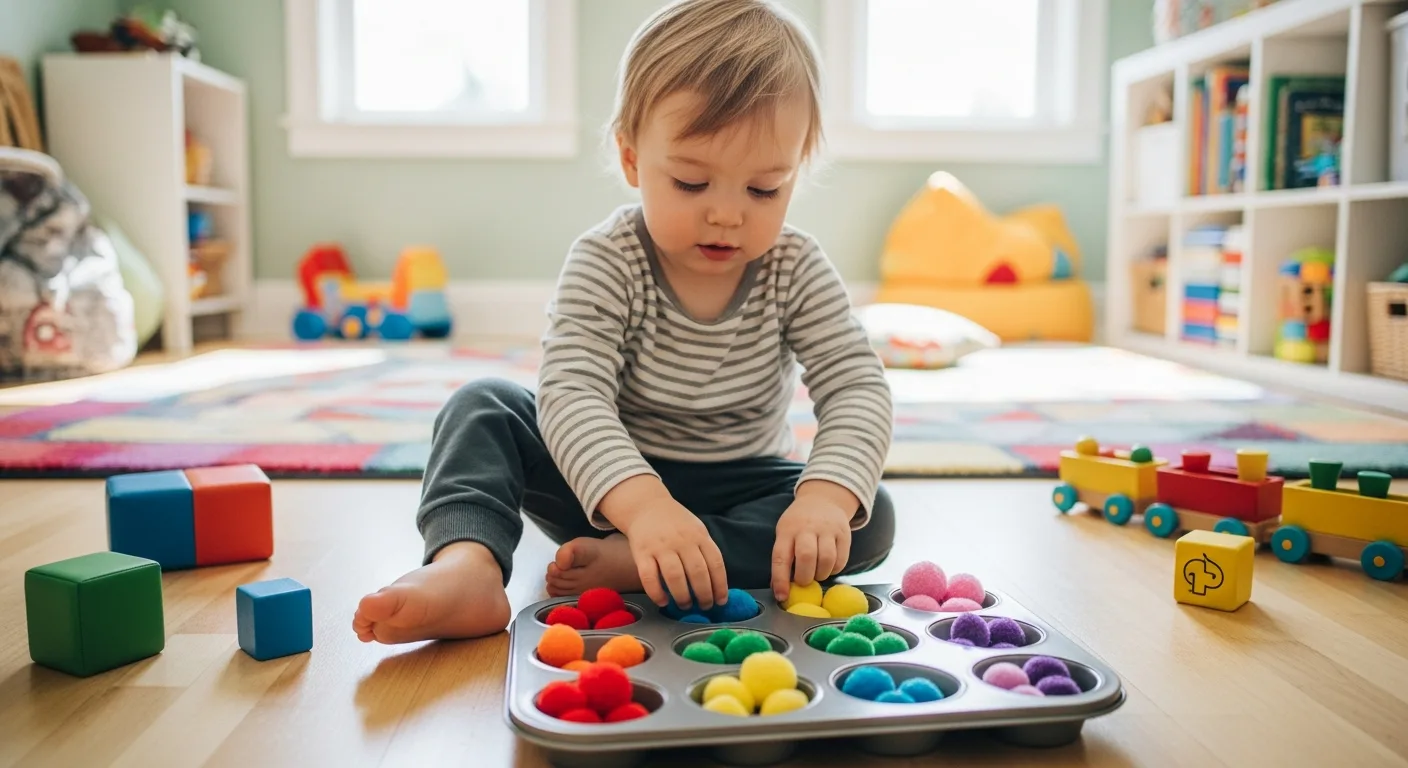
Pom pom colour sort into a muffin tin
Place a coloured piece of paper in each cup of a muffin tin and let toddlers sort pom poms by matching colour.
Why it works: Muffin tins provide clear, contained individual spaces that make the sorting task achievable and satisfying. The small pom poms also build the pincer grip.
Quick tip: Use tongs or small wooden tweezers instead of fingers to increase the fine motor challenge for older toddlers.
Rainbow pasta colour sort
Dye dried pasta different colours and let toddlers sort it into matching bowls or cups.
Why it works: Pasta is easy to handle, the sorting is clear and achievable, and the rainbow of colours makes the activity visually engaging.
Quick tip: Dye pasta by tossing it in a zip-lock bag with food colouring and a little rubbing alcohol. Spread on paper to dry before using.
Colour scavenger hunt around the house
Give your toddler a coloured card and challenge them to find five things in the house that match that colour.
Why it works: Scavenger hunts build colour generalisation — understanding that red applies to a tomato, a cushion, and a fire engine, not just a red crayon.
Quick tip: Start with bold primary colours that are easy to find. Pastels and unusual colours are a good challenge for older toddlers.
Sorting socks by colour
Empty a laundry basket of single socks and let your toddler match and sort them into colour pairs.
Why it works: Sock sorting is a real-world task that children find satisfying precisely because it is something adults do. It also develops matching and classification skills.
Quick tip: Keep a dedicated 'sorting sock' bag with deliberately mismatched socks in bright colours for regular use as an activity.
Traffic light colour game
Hold up a red, yellow, or green card and let your toddler respond — stop (red), slow down (yellow), go (green) — while moving around the room.
Why it works: Traffic light games connect colours to real-world meaning, build listening skills, and provide gross motor play within a colour-learning framework.
Quick tip: Laminate your colour cards for durability. This is such a useful game that having long-lasting cards is worth the effort.
Rainbow collage on black paper
Tear or cut coloured paper and tissue into strips and arrange them in rainbow order on a black backing sheet.
Why it works: Black backing paper makes colours pop dramatically, which is visually rewarding and reinforces the visual distinctiveness of each colour.
Quick tip: Sort the paper into seven colour piles before starting so your toddler can pick from the right pile rather than searching.
Colour wheel painting
Draw a large circle divided into six segments on paper. Help your toddler paint each segment a different colour in wheel order.
Why it works: Creating a colour wheel helps toddlers understand that colours have a systematic relationship — a foundational art and science concept.
Quick tip: Use the finished colour wheel as a reference tool for future colour activities and keep it on the wall.
Sorting buttons by colour into egg cartons
Collect a jar of mixed-colour buttons and sort them into the sections of an egg carton, one colour per section.
Why it works: Buttons are small and interesting to handle. The egg carton provides clear individual spaces that make the sorting task concrete.
Quick tip: Supervise closely as buttons are a choking hazard. This activity is best suited to toddlers aged three and above.
Colour-coded block tower challenge
Call out a colour and challenge your toddler to build the tallest possible tower using only blocks of that colour.
Why it works: Adding a colour constraint to familiar block play makes the activity cognitively richer and builds colour identification speed.
Quick tip: After building, compare heights across colours: 'Which colour tower is tallest? Which has the fewest blocks?'
Tissue paper colour mixing experiment
Dip two different-coloured tissue paper squares in water and press together to see the colours blend onto paper underneath.
Why it works: Tissue paper transfers colour beautifully when wet, creating immediate, magical results that demonstrate how colours mix.
Quick tip: Use red and yellow to make orange, blue and yellow to make green — the classic primary colour combinations work best.
Colour matching memory card game
Make pairs of coloured cards and play a simple memory matching game, turning two cards at a time to find the pair.
Why it works: Memory card games build colour recognition, concentration, visual memory, and turn-taking — all within a format that feels like a game.
Quick tip: Start with just four pairs (eight cards) for two-year-olds and increase to eight pairs as memory and attention develop.
Nature walk colour collection
Carry a paper strip with a colour sample of different colours on a nature walk, collecting natural objects that match each one.
Why it works: This extends colour learning into the natural world and builds observational science skills alongside colour classification.
Quick tip: Create the colour strip from paint swatches from a hardware store — they come in beautiful gradations of every colour.
Rainbow fruit plate
Arrange fruits and vegetables in rainbow order on a plate — strawberries, orange, banana, kiwi, blueberries, grapes.
Why it works: Connecting colour learning to food builds real-world colour vocabulary and association. Plus, eating the rainbow is genuinely nutritious.
Quick tip: Let your toddler arrange the rainbow themselves, naming each colour as they place it. The eating can come after.
Coloured play-doh shape sorting
Make or use coloured play-doh and shape cutters in matching colours so each colour makes its own shape — red stars, blue circles, yellow squares.
Why it works: Combining colour and shape in a single activity creates a dual classification challenge that builds cognitive flexibility.
Quick tip: Keep colour and shape combinations consistent across sessions so the learning reinforces rather than confuses.
Coloured ice cube tower building
Freeze coloured water into ice cubes. Stack them on a tray, sorting by colour, watching them stick together as they melt.
Why it works: The unexpected behaviour of ice — that it sticks to itself as it melts — makes this a genuinely surprising and engaging science-meets-colour activity.
Quick tip: Use a tray with edges to contain the meltwater and add salt to explore how it affects melting speed.
How to Teach Colors Through Play
- 🗣️
Name colours consistently and constantly
Narrate colour throughout daily life: 'Here's your red cup', 'Look at those yellow flowers'. Toddlers absorb colour vocabulary through repetition in context.
- ✅
Focus on one colour at a time
Rather than trying to teach all colours simultaneously, spend a few days focused on one colour — noticing it everywhere, sorting it, painting it. Depth before breadth.
- 🎮
Make it a game, not a test
Avoid quizzing toddlers: 'What colour is this?' can create anxiety. Instead, model: 'This is blue. And this one is blue too — they match!'
- 🔄
Revisit activities regularly
Colour recognition develops through many encounters over time. Returning to the same activities across weeks is far more effective than intensive one-off sessions.
For activities that extend into shape sorting and early mathematics, our Shape Activities for Toddlers and Learning Through Play at Home guides pair well with this one.
Need more activity ideas?
Try our Toddler Activity Generator to get quick indoor and outdoor activity ideas based on your toddler's age.
Try the Toddler Activity GeneratorFinal Thoughts
Color learning activities for toddlers are most effective when they are playful, repeated, and embedded in daily life. The 15 activities here use simple, accessible materials and build genuine colour knowledge through hands-on exploration. Whether you start with pom poms in a muffin tin or a rainbow fruit plate at lunch, any of these is a rich and valuable way to support your toddler's early learning through the simple act of sorting by colour.